
Diesel Supply
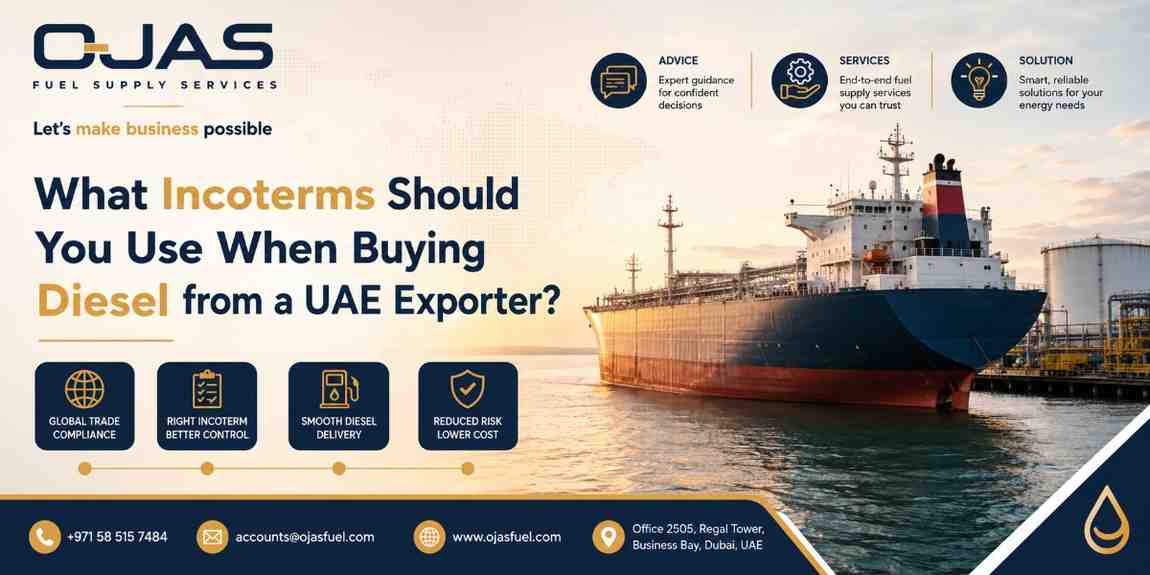
What Incoterms Should You Use When Buying Diesel from a UAE Exporter?
Key Highlights
- FOB, CIF, and CFR, under the Incoterms 2020 rules published by the International Chamber of Commerce, are the three terms most relevant to diesel imports from the UAE.
- In all three terms, risk transfers to you at the loading port, not at your destination, regardless of who’s paying for freight or insurance.
- CIF requires your supplier to arrange minimum insurance at Institute Cargo Clauses Level C, unless you’ve negotiated broader coverage in writing.
- Naming the exact loading port in your contract is one of the most commonly skipped, and costliest, details.
The three-letter term on your contract decides who pays, who insures, and who’s on the hook if something goes wrong. So choosing it carelessly is the most expensive mistake a diesel buyer can make.
If you’re buying diesel from a UAE exporter, you’ll run into three Incoterms most often: FOB, CIF, and CFR.
Each one decides who pays for shipping, who pays for insurance, and most importantly, the exact moment the fuel becomes your problem instead of the seller’s.
Get this wrong and you could end up paying for insurance you thought was included. You might also discover that your risk started the moment the diesel touched the vessel, not when it reached your port.
Moreover, these terms follow the Incoterms 2020 rules, the current edition published by the International Chamber of Commerce and the version still in force in 2026.
Why Incoterms Matter More in Fuel Trading Than Most Commodities
You’re not buying a pallet of electronics here. You’re buying a liquid bulk cargo whose freight and insurance costs swing hard with tanker availability and regional risk.
Quantity or quality disputes are also far easier for a supplier to dodge if your contract is vague about who’s responsible when.
If you don’t pin down your Incoterm precisely, you’re exposed in exactly the two places that cost the most: freight and risk transfer.
The Three Incoterms You’ll Actually Use for Diesel Shipments
1. FOB (Free on Board): What It Means for You
Under FOB, you take on risk the moment the diesel is loaded onto the vessel at the named port, commonly Jebel Ali or Fujairah for UAE exports. You arrange and pay for ocean freight and insurance yourself from that point forward.
This term suits you if you already have your own freight forwarder or prefer control over the shipping leg.
2. CIF (Cost, Insurance, Freight): What It Means for You
With CIF, your supplier arranges and pays for freight and insurance up to your destination port. Here’s the catch, though: risk still transfers to you once the cargo is loaded, not when it arrives.
Under Incoterms 2020, the seller is only required to buy minimum insurance coverage, Institute Cargo Clauses Level C, unless you’ve agreed to broader terms.
You’re covered by insurance during transit, but that minimum coverage doesn’t mean you’re fully protected. Read the certificate yourself before you rely on it.
3. CFR (Cost and Freight): What It Means for You
CFR is CIF’s leaner cousin. Your supplier pays freight to your destination port, but you’re on your own for insurance.
If you choose CFR, arrange your own marine insurance before the cargo ever leaves the loading port, not after.
| Term | Who Pays Freight | Who Pays Insurance | Risk Transfers To You |
| FOB | You | You | At the loading port |
| CIF | Seller (minimum coverage) | Seller | At the loading port |
| CFR | Seller | You | At the loading port |
Notice the pattern. In all three terms, risk transfers at the loading port. That’s the detail buyers miss most often.
Common Mistakes You Should Avoid
- Assuming CIF or CFR means you’re financially protected until arrival. You’re not. Risk shifted the moment the cargo was loaded.
- Assuming CIF insurance covers everything. It only guarantees a minimum level (Institute Cargo Clauses C) unless you’ve negotiated more.
- Failing to name the exact port in your contract instead of just “UAE” or “Gulf region.”
- Confusing casual “delivered” language with the actual legal risk-transfer point in your contract.
- Not confirming who selects the insurance provider and what the policy actually covers.
Questions You Should Ask Your Supplier Before Agreeing on Terms
- Which exact port will the diesel be loaded at, and is that named explicitly in the contract?
- If you’re quoting CIF, what level of Institute Cargo Clauses coverage applies, and can you see the policy wording?
- At what precise point does risk transfer to me under this term?
- Who arranges the independent quality and quantity inspection, and when does it happen relative to loading?
- What happens contractually if the vessel is delayed after loading but before departure?
Frequently Asked Questions
- What’s the difference between FOB and CIF for diesel?
Under FOB, you arrange and pay for freight and insurance yourself after loading. Under CIF, your supplier arranges both, but you still carry the risk from the moment of loading onward.
2. Who pays for marine insurance under CFR terms?
You do. CFR covers freight costs from the seller’s side, but insurance is entirely your responsibility to arrange.
3. Is Incoterms 2020 still the current version in 2026?
Yes. Incoterms 2020 remains the active edition. The International Chamber of Commerce updates the rules roughly once a decade, and no new edition has been published since 2020.
4. Can Incoterms be negotiated per shipment?
Yes. Incoterms are agreed per contract, not fixed by law, so you and your supplier can select different terms for different shipments based on your logistics setup.
Conclusion
Choosing the right Incoterm isn’t a formality; it’s the clause that decides who absorbs the cost if a shipment goes wrong. FOB gives you control but full responsibility from the loading port onward.
CIF and CFR shift freight costs to your supplier, but risk still transfers at loading in every case, and CIF’s insurance only guarantees a minimum level of coverage unless you negotiate otherwise.
Before you sign anything, confirm the exact port, the insurance clause level, and the inspection timeline in writing, referencing Incoterms 2020 explicitly.
Ready to Discuss Terms for Your Next Shipment?
Whether you need FOB, CIF, or CFR terms, get in touch with our team to confirm loading ports, freight arrangements, and inspection timelines before you sign anything.