Ojas Fuel
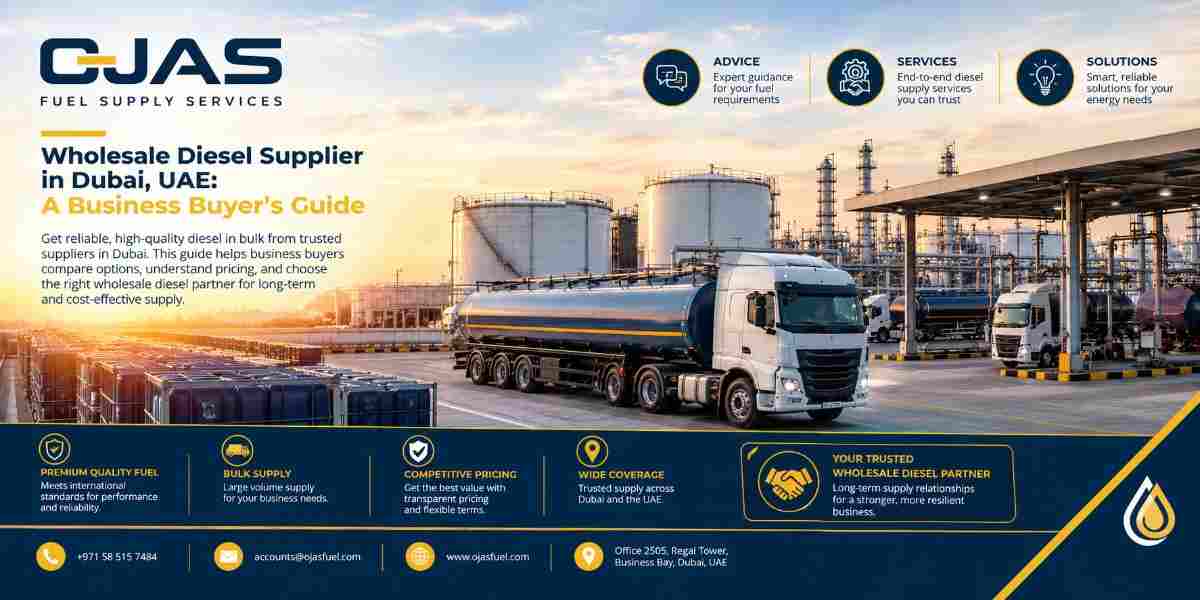
Wholesale Diesel Supplier in Dubai, UAE: A Business Buyer’s Guide
Summary
- Verify supplier Trading Permits under Federal Law No. 14 of 2017 to ensure lawful petroleum procurement.
- Cross-border documentation strictly adheres to ICC Incoterms 2020, managing risk across all UAE port gateways.
- Bulk Supply Planning requires a universal minimum order quantity of 13,000 Imperial Gallons from Ojas.
Before committing to a bulk fuel purchase, always confirm that your wholesale diesel supplier holds a valid Trading Permit issued by the Competent Authority.
Partnering with an unlicensed entity exposes your business to severe financial and legal risks, so checking this documentation upfront ensures your supply coordination remains completely protected and legally sound.
The wholesale trade of energy commodities operates under strict federal oversight designed to safeguard the national economy and market integrity.
Under Federal Law No. 14 of 2017 on Petroleum Products Trading, any individual or business engaging in the trading of petroleum products within the UAE must hold a specific Trading Permit.
This regulatory definition covers everything from the storage and transport to the distribution and sale of petroleum commodities across the region.
Procurement departments face profound liability if they acquire petroleum products from unauthorized actors. The federal law classifies unlicensed trading as a punishable offense, carrying heavy initial fines and potential equipment confiscation.
Furthermore, recognizing compliant entities is essential for proper corporate tax structuring. Recent updates to UAE tax laws, specifically regarding Qualifying Commodities, outline favorable corporate tax mechanics for physical energy trading within designated zones.
Keep reading the article to learn more.
What are the exact specifications for wholesale 10 ppm diesel in the UAE?
Wholesale 10 ppm diesel supplied across the UAE strictly aligns with the EN 590 standard. Critical parameters include a maximum sulfur content of 10 mg/kg, a minimum cetane index of 46, and a standardized density profile.
This exact chemical composition ensures heavy equipment fuel supply coordination meets modern environmental and performance limits.
Both domestic and export markets mandate the use of 10 PPM Ultra-Low-Sulphur Diesel (EN 590) to significantly reduce environmental pollutants and protect the catalytic converters in modern heavy machinery.
The Ministry of Industry and Advanced Technology governs these chemical specifications through the UAE.S 477 standard.
To guarantee compliance, independent testing laboratories verify these chemical profiles using precise ASTM methodologies before issuing a Certificate of Analysis to the procurement buyer.
Sulfur content is strictly quantified using ultraviolet fluorescence to ensure the 10 ppm threshold is never exceeded during bulk supply operations.
Density also remains a vital metric for accurate volumetric calculations during logistics coordination, measured precisely at a constant 15 degrees Celsius.
| Specification Parameter | Mandated Limit | Standard Test Method |
| Sulfur Content | Maximum 10 mg/kg | ASTM D5453 |
| Density at 15 Degrees Celsius | 820 to 845 kg/m³ | ASTM D4052 |
| Cetane Index | Minimum 46 | ASTM D4737 |
| Flash Point | Minimum 65 Degrees Celsius | ASTM D93 |
What documentation is required for marine bunkering at Fujairah and Jebel Ali?
You require a compliant Bunker Delivery Note containing the receiving vessel’s IMO number, delivery date, fuel density, and sulfur declaration.
Under 2026 European maritime regulations, a verifiable Bunker Delivery Note is critical for managing marine bunkering liabilities regarding EU ETS and FuelEU Maritime standards.
For Marine Diesel Oil (MDO) transfers at strategic hubs like Fujairah Port and Jebel Ali Port, strict adherence to maritime documentation is mandatory.
Vessels must submit specific pre-arrival paperwork and complete rigorous safety checklists before initiating any operations. The Bunker Delivery Note serves as the primary legal record of the transfer, detailing the exact quantity and chemical profile of the fuel delivered to the vessel.
The financial implications of precise documentation have expanded drastically due to the 2026 integration of the EU Emissions Trading System for maritime operations.
Under these updated European regulations, shipping companies must monitor and report greenhouse gas emissions on a strict per-voyage basis, now including carbon dioxide, methane, and nitrous oxide.
Accurate volumetric data from the Bunker Delivery Note allows operators to calculate their precise carbon exposure and maintain seamless compliance across international waters.
Coordinating Cross-Border Supply Using ICC Incoterms 2020
Your cross-border documentation must align with ICC Incoterms 2020 to clearly define cost allocations, risk transfer points, and insurance obligations.
Establishing exact commercial terms prevents logistical disputes and ensures transparent liability management. This structured approach guarantees absolute clarity during Import/Export Facilitation.
When organizing shipments to trading partners in the Asia-Pacific or European markets, selecting the correct Incoterm dictates the entire logistical framework.
Under a Cost, Insurance, and Freight (CIF) agreement, the seller pays the freight and minimum insurance to the destination port, but the risk transfers to the buyer as soon as the goods are safely loaded on the vessel at the origin port.
This critical distinction between cost transfer and risk transfer remains a fundamental principle of maritime energy trading.
Alternatively, Free On Board (FOB) terms place the responsibility for main carriage costs entirely on the buyer once the product passes the ship rail at the loading terminal.
Professional supply coordination relies on these standardized rules to structure cross-border documentation flawlessly, ensuring you understand your exact obligations regarding export clearance, freight payments, and cargo insurance.
Can you export AFRI-6 equivalent diesel to African markets?
Yes, you can easily source AFRI-6-equivalent ultra-low-sulfur diesel from UAE port gateways for export to East, Central, and West Africa.
The 10 PPM Ultra-Low-Sulphur Diesel (EN 590) inherently meets the stringent African Refiners and Distributors Association standards, ensuring smooth customs clearance at your port of discharge.
Historically, diesel imported into various African regions featured high sulfur variability, which prompted the African Refiners and Distributors Association to implement the AFRI-6 standard to harmonize downstream fuel quality.
This environmental regulation strictly mandates a maximum sulfur content of 10 ppm for all gas oil and diesel imports entering the continent.
The 10 PPM Ultra-Low-Sulphur Diesel (EN 590) arranged from the UAE perfectly mirrors this required chemical profile, eliminating any compliance friction at the border.
By leveraging expert coordination through Hamriyah Port or Khalifa Port, buyers secure the exact cross-border documentation required by destination customs authorities.
This precise coordination completely bypasses local refining limitations, securing continuous access to clean, specification-grade fuel imports for developing regional infrastructure.
Executing Your Order: Bulk Supply Planning and Commercial Terms
To execute a bulk order, you must meet a universal minimum order quantity of 13,000 Imperial Gallons, which is offered by Ojas.
Accepted commercial payment terms are limited to Upfront, Cash on Delivery, or Bank Transfer on Delivery Before Offloading, ensuring financial security and streamlined logistics across your entire distribution channel.
Procurement discipline is maintained by enforcing this baseline volume of 13,000 Imperial Gallons per transaction across all UAE port gateways.
Financial security within the trading framework relies heavily on rigid commercial payment structures to protect all involved parties. The prohibition of unauthorized credit terms insulates the regional supply corridor from default risks.
Product availability, pricing, and delivery lead time remain subject to market conditions, product source, destination, and commercial terms agreed at the order stage.
Frequently Asked Questions
1. What is the minimum order volume for bulk diesel delivery from Ojas?
Your absolute minimum order quantity for Bulk Supply Planning is 13,000 Imperial Gallons per transaction.
This baseline volume applies seamlessly to both domestic distribution and international export shipments for both 10 PPM Ultra-Low-Sulphur Diesel (EN 590) and Marine Diesel Oil (MDO).
2. What payment methods are accepted for diesel trading from Ojas?
Transactions are processed exclusively via Upfront payment, Cash on Delivery, or Bank Transfer on Delivery Before Offloading.
These standardized payment terms apply strictly across all product categories and port locations to mitigate supply chain risk and prevent unauthorized credit defaults.
2. Are export facilitation services available for European markets?
Yes, Import/Export Facilitation to European markets operates smoothly through strategic hubs like Jebel Ali Port and Fujairah Port.
The coordinated supply exclusively features EN 590/Euro V-aligned ultra-low-sulfur diesel, ensuring complete alignment with rigorous metric unit standards and regional customs requirements.
3. Does the marine fuel coordination service handle Marine Gas Oil?
No, the Marine Fuel Coordination service focuses exclusively on arranging Marine Diesel Oil (MDO).
Deliveries are carefully organized through approved channels at Fujairah Port and Jebel Ali Port, ensuring adherence to maritime regulations and the timely issuance of verifiable Bunker Delivery Notes.
4. Is the exported diesel compliant with African AFRI-6 mandates?
Yes, the 10 PPM Ultra-Low-Sulfur Diesel (EN 590) functions perfectly as an AFRI-6 equivalent product.
Supply coordination to East, Central, and West Africa includes all necessary cross-border documentation required by destination customs authorities, subject to the standard minimum order quantity.
Next Steps for Commercial Procurement
Securing a reliable energy supply requires a partner capable of executing disciplined Bulk Supply Planning and comprehensive logistics management.
Commercial buyers navigating the complexities of regional procurement benefit from structured supply coordination that ensures continuous fleet operation and overall business stability.
By leveraging deep expertise in cross-border documentation and major UAE port gateways, your procurement department can seamlessly acquire specification-grade petroleum products without regulatory friction.