Ojas Fuel
Single Supplier vs. Multiple Diesel Suppliers: Which Is Safer for Business Procurement?
Summary
- Consolidating fuel procurement with a single entity exposes operations to localized shortages and insolvency risks.
- Engaging multiple diesel suppliers builds essential redundancy for continuous fleet and plant fuel operations.
- Utilizing UAE port gateways bypasses regional maritime chokepoints and secures export continuity.
- Strategic diversification guarantees the continuous delivery of compliant 10 PPM Ultra-Low-Sulphur Diesel (EN 590).
- Professional coordinators arrange dependable procurement through structured Bulk Supply Planning and rigorous supplier vetting.
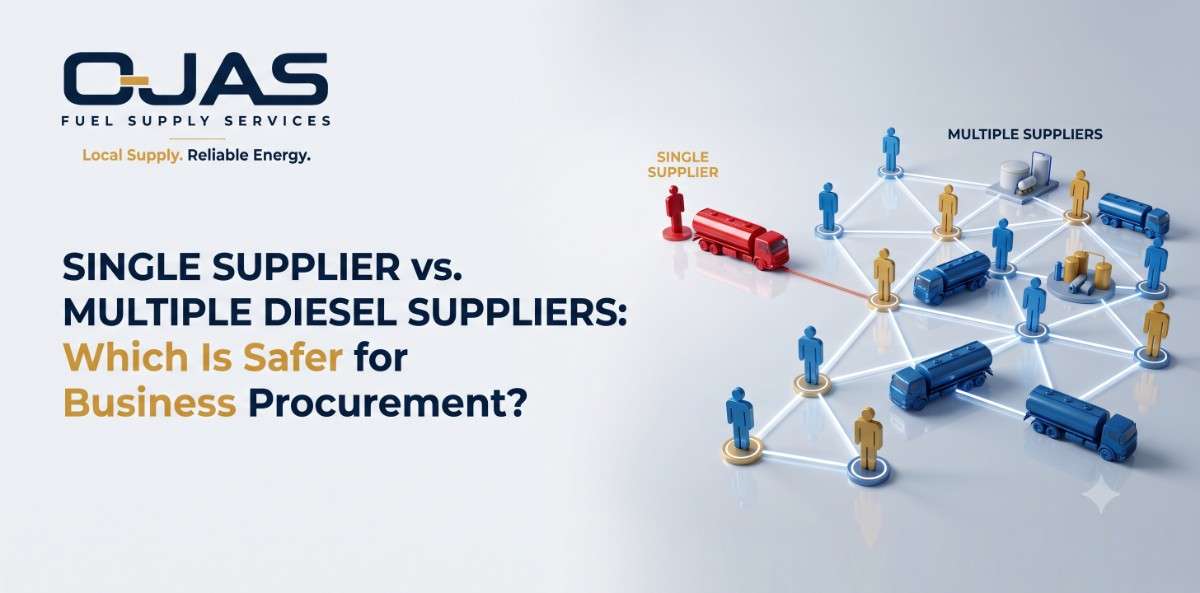
Relying on a single vendor removes operational slack and transforms localized delivery delays into immediate commercial disruptions.
While single sourcing consolidates administration, it leaves buyers highly vulnerable to inventory depletion. Diversifying trading networks across multiple diesel suppliers ensures continuous access to fuel during sudden regional shortages.
The structural dependency of single-source procurement introduces acute vulnerabilities into commercial operations. A buyer tethered to a solitary supplier absorbs the entirety of that vendor’s localized risks, including logistical bottlenecks, credit facility withdrawals, or sudden inventory depletion.
The global market for middle distillates remains complex, and a singular supplier facing transportation delays cannot immediately rectify a sudden shortage of commercially deliverable 10 PPM Ultra-Low-Sulphur Diesel (EN 590). Procurement teams require continuous site fuel planning to meet plant fuel requirements consistently without disruption.
Furthermore, the regulatory framework governing UAE energy procurement requires absolute adherence to statutory licensing to prevent unauthorized distribution.
Keep reading the article to learn more.
How does multiple sourcing improve bulk diesel supply reliability?
A multiple sourcing framework structurally improves bulk diesel supply reliability by providing immediate alternatives when primary vendors fail.
This methodology prevents stock-outs and shields industrial operations from sudden delivery fleet constraints. Procurement buyers maintain continuous energy access despite unforeseen vendor insolvency or localized market shocks.
Transitioning to a strategy that utilizes multiple diesel suppliers fundamentally reconfigures a buyer’s risk profile. In industrial applications where operational delays directly translate to cost leakage and service disruption, maintaining a diversified vendor matrix operates as a mandatory safeguard.
The integration of multiple supply nodes ensures that demand variations do not cascade into complete operational halts. To support this infrastructure, official documentation from DP World confirms that Jebel Ali Port delivers advanced liquid bulk handling capabilities to support immense regional logistics scale.
| Sourcing Strategy | Primary Vulnerability | Strategic Advantage | Operational Impact on Bulk Supply |
| Single Sourcing | Zero immediate alternatives during vendor insolvency or local disruption. | Streamlined administration and deep vendor integration. | High risk of stock-outs if the primary supplier encounters refinery constraints. |
| Multiple Sourcing | Increased administrative complexity in coordinating deliveries. | Built-in redundancy and competitive commercial execution. | Ensures continuous delivery of 10 PPM Ultra-Low-Sulfur Diesel (EN 590). |
For reliable execution, redundancy requires strict commercial discipline across the procurement network. Buyers leveraging multiple diesel suppliers must ensure that each node can consistently fulfill the minimum order quantity of 13,000 Imperial Gallons (IG) of Ojas. For European buyers specifically, 13,000 IG is approximately 59,100 liters, roughly 49 metric tons of diesel, density-dependent.
Ojas Fuel Supply Services LLC coordinates this standard order threshold across both 10 PPM Ultra-Low-Sulphur Diesel (EN 590) and Marine Diesel Oil (MDO).
Product availability, pricing, and delivery lead time remain subject to market conditions, product source, destination, and commercial terms agreed at the order stage.
Acceptable standard payment terms from Ojas are limited to up-front, Cash on Delivery, or Bank Transfer on Delivery Before Offloading only.
How does multiple sourcing mitigate regional disruption risks for export?
Sourcing petroleum import and export volumes through multiple UAE port gateways bypasses isolated maritime chokepoints.
Maintaining supplier and port diversity ensures uninterrupted export continuity for dependent European and African markets. This strategy mitigates delays amidst ongoing shipping disruptions affecting major global transit routes.
Global supply chain resilience relies heavily on geographical routing and infrastructure diversity. The international market faces compounding pressures, proving that physical proximity to a resource does not always guarantee secure delivery.
A single-supplier strategy utilizing only one geographical export node represents a critical vulnerability for international buyers. A robust strategy for Import/Export Facilitation leverages multiple diesel suppliers through dual strategic gateways like Jebel Ali Port and Fujairah Port.
Recent assessments by the International Energy Agency (IEA) highlight the necessity of regional supply corridors, noting that approximately 14.95 million barrels per day of crude oil and vast product volumes transit the Strait of Hormuz.
The IEA further confirms that the UAE operates the ADCOP pipeline, which bypasses the Strait to deliver crude to Fujairah with a 1.5 million barrels per day capacity.
If maritime traffic slows at one node, the alternative port serves as a vital pressure release valve. This infrastructure diversity secures stable logistics pathways so that EN 590/Euro V-aligned diesel reaches destination markets without critical delays.
Which sourcing model guarantees ESMA compliance for ULSD?
Domestic diesel distribution requires absolute adherence to federal quality limits, achievable through strict verification across all vendors.
Multiple verified suppliers provide redundant quality assurance for industrial operations. This prevents a single contaminated batch from halting machinery or damaging sensitive exhaust gas treatment devices.
Ensuring specification-grade fuel quality constitutes a strict statutory requirement rather than merely an operational preference. The environmental and mechanical demands of modern fleets necessitate ultra-low-sulphur fuels to optimize engine performance and reduce emissions.
The Emirates Authority for Standardization and Metrology (ESMA) requires that diesel used within the UAE comply with a strict 10 ppm sulfur content maximum. Sourcing fuel that fails to meet these parameters exposes buyers to regulatory penalties and mechanical degradation.
To secure compliance across a network of multiple diesel suppliers, buyers must enforce uniform verification protocols during diesel distribution. Procurement teams must mandate the provision of a Certificate of Analysis for every batch prior to offloading.
Relying on multiple diesel suppliers who strictly adhere to these compliance steps ensures that a quality failure by one vendor does not jeopardize an entire logistics network.
What documentation is critical when managing multiple bunkering suppliers?
Managing multiple marine bunkering suppliers requires strict control over delivery documentation and clear trade terms. Transparent commercial payment terms rely entirely on verified paperwork to ensure lawful transfers. Utilizing precise Incoterms and standardized delivery notes facilitates smooth and compliant marine fuel transfers.
The maritime regulatory environment requires exacting documentation to prevent the transfer of non-compliant fuels. When buyers diversify anchorage-side coordination across different suppliers, the risk of documentary inconsistency increases.
Official documentation from Fujairah Port confirms that dedicated bunkering berths implement strict loading and discharge operations to support the 0.5 percent sulfur cap regulation. Every Marine Diesel Oil (MDO) order requires comprehensive documentation detailing density and exact sulfur content to satisfy these environmental thresholds.
Furthermore, structured trade facilitation demands precise delivery terms to determine risk transfer points. The ICC Incoterms 2020 define standardized trade rules, dictating that under Delivered at Place (DAP) terms, the seller delivers when the goods are placed at the disposal of the buyer on the arriving means of transport, ready for unloading.
Conversely, Free On Board (FOB) terms pass the risk once the goods are loaded on board the vessel. By aligning Marine Fuel Coordination with official ICC Incoterms 2020 definitions, procurement buyers establish seamless cross-border documentation and clear payment clarity across the entire supplier matrix.
Frequently Asked Questions
1. Why is 10 ppm diesel required for modern engines?
Automotive gas oil with a maximum sulfur content of 10 ppm prevents damage to advanced exhaust gas treatment devices. Bulk Supply Planning of compliant fuel ensures modern fleets meet environmental standards while optimizing engine performance and reducing maintenance costs.
2. What is the minimum order for bulk diesel supply from Ojas?
To ensure operational efficiency, the minimum order quantity is strictly 13,000 Imperial Gallons (IG) per order.
For European metrics, this equals approximately 59,100 liters or roughly 49 metric tons. This standard applies universally across all 10 PPM Ultra-Low-Sulphur Diesel (EN 590) and Marine Diesel Oil (MDO) transactions.
3. What payment terms are accepted for diesel trading for Ojas?
Financial security and transparency remain paramount for operations. Standard payment terms are limited to Upfront, Cash on Delivery, or Bank Transfer on Delivery Before Offloading only. These structured terms ensure clear commercial execution prior to product discharge across all ports and products.
4. Can multiple suppliers facilitate exports to Europe and Africa?
Yes. Utilizing multiple diesel suppliers across Jebel Ali Port and Fujairah Port ensures robust import and export capabilities. This dual-port strategy bypasses regional logistics disruptions, guaranteeing that compliant diesel reaches Central Asia, Africa, or European markets seamlessly and on schedule.
5. What is required for compliant marine bunkering?
Compliant coordination of Marine Diesel Oil (MDO) requires absolute specification discipline. Every delivery must include documentation confirming precise sulphur limits and density. Coordinating MDO supply for orders starting at 13,000 Imperial Gallons (IG) supports marine operations securely and legally.
Strategic Procurement Initiation
To protect the supply chain against regional disruption and establish a highly redundant procurement strategy, buyers require professional supply coordination that understands commercial discipline.
Dependable energy access relies on controlled supplier relationships and transparent documentation.
By maintaining clear communication and responsible execution across key UAE port gateways, including Jebel Ali and in Fujairah, procurement teams can remove unnecessary complexity from fuel acquisition.
Whether operations require continuous site fuel planning or strategic anchorage-side coordination, ensuring essential energy movement remains structured is critical.