Diesel Supply
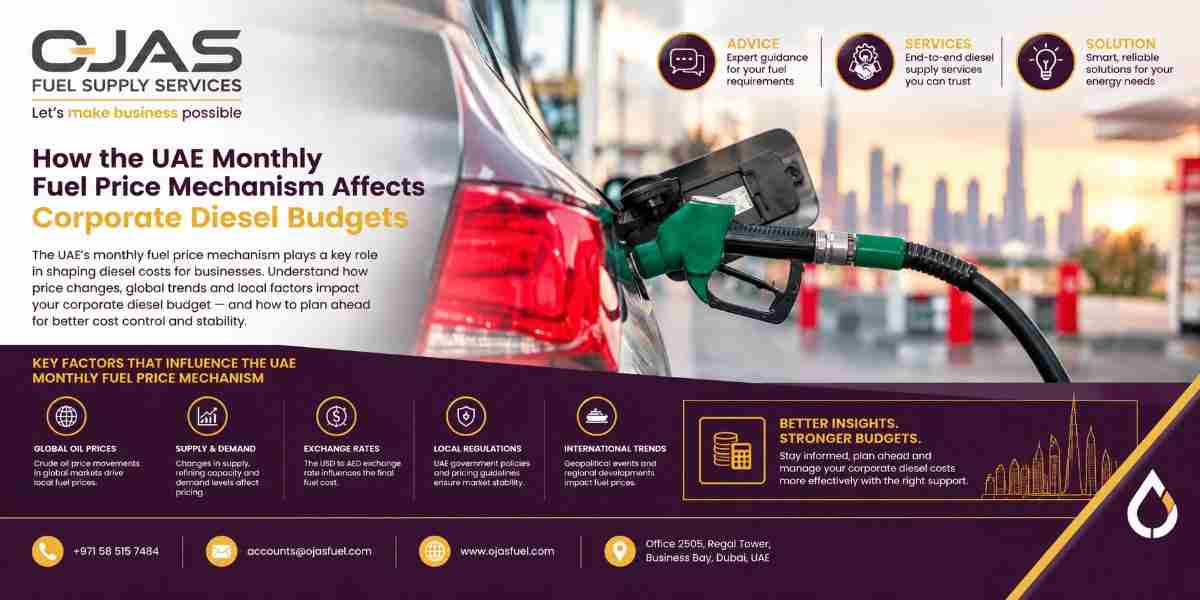
How the UAE Monthly Fuel Price Mechanism Affects Corporate Diesel Budgets
The United Arab Emirates’ transition away from heavily subsidized energy markets represents a critical structural shift in the nation’s economic history.
Prior to the summer of 2015, the UAE maintained fixed, heavily subsidized domestic fuel prices. This approach was designed to insulate consumers and industries from the extreme volatility of the global petroleum trade.
While this strategy provided operational predictability, it severely strained federal budgets over time. The International Monetary Fund (IMF) estimated that explicit energy subsidies cost the UAE government billions annually.
Furthermore, the opportunity cost of not selling that fuel at international market rates exceeded $73 billion across the Gulf Cooperation Council.
In response, the UAE Ministry of Energy enacted a landmark policy shift to officially deregulate domestic gasoline and diesel prices on August 1, 2015. This deregulation permanently tethered local retail prices directly to the fluctuations of the global energy market.
By dismantling the fixed-price regime, the government aimed to rationalize consumption, promote alternative energy adoption, and enhance economic competitiveness. However, this ongoing market exposure fundamentally altered how domestic businesses must operate.
Industries heavily reliant on middle distillates—such as construction and heavy logistics—can no longer rely on static annual energy budgets. Understanding the mechanics of the UAE’s monthly fuel price resets is now a mandatory competency for procurement teams managing bulk diesel supply.
How does the UAE monthly fuel price mechanism work for diesel?
The UAE reviews and adjusts retail fuel prices through a strict, transparent monthly pricing mechanism. This system tracks movements in global energy prices while reflecting changes and requirements within the domestic market.
Current prices are calculated by analyzing international crude oil benchmarks and refined-product market pressures.
Because these macroeconomic indicators shift continuously, the national committee announces new diesel rates at month-end. These new rates are effective from the first day of the next month.
The Gasoline and Diesel Prices Follow-up Committee executes this transition through a rigid three-step timeline:
- Announcement: The national committee convenes to review global indices and officially announces the revised fuel rates on the final day of the ongoing month. For example, the committee approved the October 2026 rates on September 30, 2026.
- Effective Date: The newly announced retail rates take binding legal effect uniformly across all seven emirates. This transition occurs at exactly 00:01 on the first day of the subsequent month.
- Budget Reset: Immediately following the announcement, corporate fleet managers and industrial procurement officers must reconcile their operational forecasts. They must apply the new benchmark rate to their anticipated monthly consumption to prevent budget deficits.
How much can a monthly diesel price change cost my company?
The financial exposure created by month-to-month volatility can be immense, particularly for industrial operations consuming bulk volumes.
Over the third quarter of 2026, the UAE retail diesel market experienced aggressive and sustained upward momentum. Retail diesel moved from AED 3.80 per liter in August 2026 to AED 4.30 in September and reached AED 4.80 in October.
These adjustments represent consecutive month-on-month increases of approximately 13.1% and 11.6%, pressuring corporate bottom lines.
To accurately contextualize this exposure, organizations must calculate the impact on standard bulk procurement orders.
On one minimum order of 13,000 Imperial Gallons (59,099 liters), each AED 0.50 step shifts the fuel cost by roughly AED 29,550.
The physical operating environment further exacerbates these compounding costs. The UAE construction sector relies heavily on diesel-powered generators to power sites lacking grid connectivity.
During the intense UAE summer months, diesel engines suffer thermal derating, increasing baseline fuel consumption by 8% to 12%.
A standard 500 kVA generator running at an optimal 75% load will consume approximately 75 liters of diesel per hour.
Running 24 hours a day, a single generator will burn through over 54,000 liters in just one month. When the per-litre price jumps by AED 0.50, the unbudgeted cost for just one generator surges by over AED 27,000 per month.
| Month (2026) | Retail Diesel Price (AED/liter) | Benchmark Cost for 59,099 Liters (AED) |
| August | 3.80 | ~224,576 |
| September | 4.30 | ~254,126 |
| October | 4.80 | ~283,675 |
Note: The figures listed above represent the national retail benchmark, not an OJAS quote. OJAS operates with a minimum order quantity (MOQ) of 13,000 Imperial Gallons (59,099 liters) per delivery.
Is the monthly retail diesel price the same as a bulk diesel quote?
No, the monthly committee rate is a retail benchmark strictly designed to cap prices at consumer dispensing stations.
A bulk diesel order is priced in a written quotation agreed upon at the order stage. This bulk price depends on real-time market conditions, product source, destination logistics, and commercial terms.
Corporate procurement teams must use the retail rate to forecast the overarching budget and the written quotation to officially commit to it. This divergence between retail pump prices and bulk B2B quotations is driven by complex regulatory compliance and supply chain overhead.
Bulk petroleum supply in the UAE is highly regulated to ensure safety and quality. Under Cabinet Resolution No. 21 of 2015, all petroleum products must meet approved standards and undergo conformity assessments by ESMA. For diesel, this mandates strict adherence to the UAE.S 477 specification for 10 PPM EN 590 ultra-low-sulfur diesel.
Additionally, moving bulk hazardous materials requires strict adherence to Civil Defence guidelines and SIRA regulations.
For international trading through major logistical hubs like DP World’s Jebel Ali Port or the Port of Fujairah, distinct export tariffs and marine specifications further separate commercial pricing from the domestic benchmark.
A professional written quotation synthesizes all these market variables. It will explicitly state the following details:
- Total volume and unit of measurement
- Chemical specification (e.g., 10 PPM EN 590 ULSD)
- Designated delivery emirate
- Agreed payment term.
Why are diesel prices still volatile in 2026?
The sustained volatility of diesel prices in 2026 is the direct result of a fragile global supply chain balancing localized production deficits against persistent geopolitical disruptions.
The International Energy Agency’s (IEA) September 2026 Oil Market Report explicitly defers a full Middle East supply recovery to 2027.
Escalating conflicts and maritime security threats surrounding the Strait of Hormuz and the Bab el-Mandeb Strait have severely constrained regional energy exports.
In August 2026, Gulf net diesel and gasoil exports plummeted to an average of just 390,000 barrels per day—about one-quarter of pre-war levels.
Simultaneously, Western distillate markets remain structurally tight and heavily depleted. The U.S. Energy Information Administration (EIA) projects that U.S. distillate fuel oil inventories will drop below the critical threshold of 100 million barrels in September.
This tightness has pushed domestic U.S. diesel crack spreads higher, incentivizing refiners to export limited yields rather than rebuild stockpiles.
Because commercial inventory buffers are rapidly depleting globally, any minor disruption to refining capacity or shipping lanes translates immediately into price spikes.
Consequently, corporate buyers in the UAE must operate under the assumption that monthly resets may stay upward-biased in the near term.
How do I budget and order bulk diesel when prices reset monthly?
Operating efficiently in an environment of systemic price volatility requires rigid discipline in both financial forecasting and physical procurement. Businesses must transition away from reactive purchasing and adopt a highly structured approach to fuel management.
To effectively manage financial exposure, procurement controllers should set the budget from the latest committee rate. They should then add a variance buffer sized from recent monthly swings and strictly order in full minimum quantities.
To ensure supply continuity and financial predictability, organizations should execute the following steps:
- Capture Requirement: Accurately measure site tank levels and generator load profiles to determine the exact volume required, geographical location, and operational timing.
- Request Quotation: Submit the captured requirements to the supplier to receive a market-linked commercial offer based on real-time spot market conditions.
- Confirm Payment Term: Ensure internal accounts payable departments are prepared to execute the agreed settlement method to prevent dispatch delays.
- Schedule Delivery: Coordinate with site supervisors and civil defense personnel to ensure the delivery facility is prepared to receive the hazardous material.
- Reconcile Documentation: Upon offloading, conduct a rigorous cross-check of the Delivery Note, Invoice, and Certificate of Analysis to ensure ESMA compliance.
Operational discipline is also critically required on-site to maximize the yield of every purchased liter.
Site managers must actively prevent “wet stacking”—a condition where generators run at low loads, destroying fuel efficiency and damaging the engine.
By properly sizing generators and running them at an optimal 75% load capacity, businesses can reduce wasted consumption by up to 20%.
FAQs
1. When are UAE diesel prices announced?
A national fuel price committee announces diesel rates on the last day of each month, effective from the first day of the following month.
The October 2026 rates were announced on 30 September 2026. Buyers should confirm the current rate on official government portals before finalizing budgets.
2. What is OJAS’s minimum diesel order?
OJAS accepts bulk diesel orders from a minimum of 13,000 Imperial Gallons (59,099 liters) per order.
Orders below this quantity fall outside standard bulk supply logistics. Buyers should strategically consolidate their fuel requirements across multiple sites into a single delivery where operations allow.
3. What payment terms does OJAS accept?
OJAS strictly accepts three payment terms: Upfront, Cash on Delivery, or Bank Transfer Before Offloading.
No other credit terms apply without explicit management confirmation. Buyers should clearly state their preferred term in the initial quote request to synchronize commercial offers.
4. Does OJAS supply 10 ppm diesel across the UAE?
Yes, OJAS supplies 10 PPM EN 590 ultra-low-sulfur diesel for domestic delivery across all seven Emirates.
The product is a premium automotive gas oil suited to high-stress commercial fleets and generators. The delivery emirate and total volume are formally confirmed in the written quotation.
5. Does OJAS supply diesel to Europe and Africa?
OJAS supplies export markets in Europe and Africa through Jebel Ali Port and Fujairah Port, the two confirmed international trade gateways.
Because export duties and customs rules differ by destination country, international buyers should explicitly name the final destination in their quote request.
Conclusion
Please ensure you clearly state your required volume, the designated delivery emirate, and your preferred payment term to initiate immediate supply coordination.