Diesel Supply
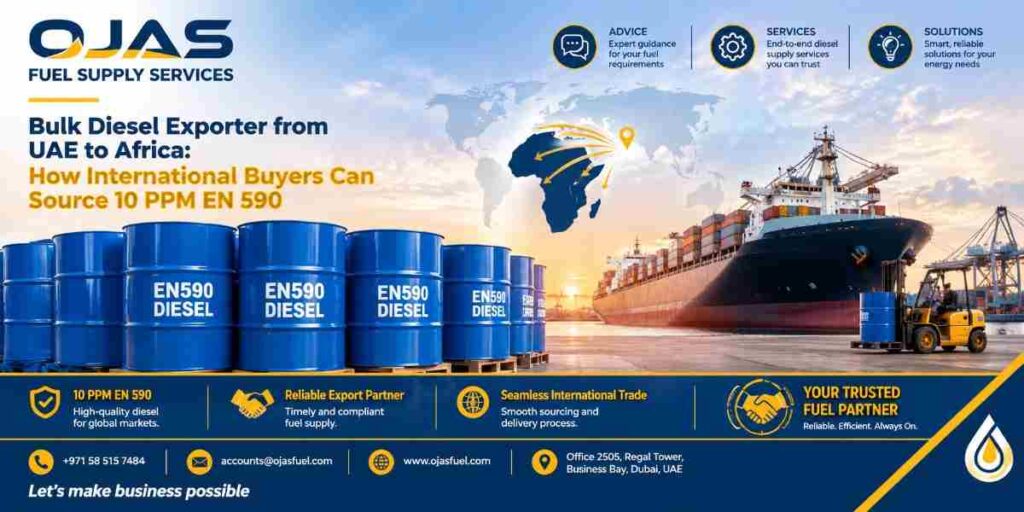
10 PPM EN 590 Diesel Export from Dubai: Bulk Cargo Requirements for International Buyers
Key Highlights
- Sourcing bulk petroleum products mandates strict compliance with Federal Law No. 14 of 2017 to prevent illegal trading.
- Cargo specifications follow MoIAT UAE.S 477 standards to ensure safe maritime handling in high-ambient environments.
- Export clearance requires precise alignment with Dubai Customs Mirsal 2 and the standard 8-digit HS code export protocols (or 12-digit codes strictly for GCC-bound shipments).
- Shipments to European and African markets demand targeted destination compliance, including EUR-Lex and AFRI-6 alignments.
Exporting 10 PPM Ultra-Low-Sulphur Diesel (EN 590) strictly requires a valid trading permit issued under Federal Law No. 14 of 2017. Procuring bulk fuel from unlicensed entities constitutes illegal trading across the UAE.
This violation carries severe administrative fines reaching AED 500,000 and the confiscation of the involved petroleum products according to the official UAE legislation portal.
The regulatory architecture governing the energy sector places heavy compliance burdens on both the supplier and you as the international buyer.
Federal Law No. 14 of 2017 establishes a centralized registry and mandates that all storage, distribution, and export of petroleum products route exclusively through vetted, licensed entities.
This systemic tightening eradicates unauthorized trading and mitigates long-term smuggling risks. You must audit prospective suppliers for this specific federal permit before initiating any commercial negotiations.
This stringent legal framework necessitates engaging a compliant partner for your Supply Coordination to mitigate regulatory exposure.
Product availability, pricing, and delivery lead time remain subject to market conditions, product source, destination, and commercial terms agreed at the order stage.
What are the MoIAT specifications for 10 ppm EN 590 diesel?
The UAE Ministry of Industry and Advanced Technology (MoIAT) enforces the strict UAE.S 477 standard for 10 ppm gas oil alongside international EN 590 benchmarks.
UAE.S 477 mandates a maximum sulfur content of 10 mg/kg and a minimum cetane index of 50.0, whereas European EN 590 requires a minimum cetane number of 51.0 and destination-specific Cold Filter Plugging Point (CFPP) limits.
It also enforces a minimum flash point of 65 degrees Celsius to ensure safe handling.
Product availability, pricing, and delivery lead time remain subject to market conditions, product source, destination, and commercial terms agreed at the order stage.
The UAE.S 477 specification framework aligns domestic UAE production with advanced international standards while adapting to regional climatic realities. The elevated minimum flash point of 65 degrees Celsius acts as a critical safety adaptation for bulk storage and maritime transport through the Arabian Gulf.
This requirement minimizes the risk of vapor ignition during high-temperature loading operations at coastal terminals. Verifying this parameter through a Certificate of Analysis protects your vessel during loading.
The strict 10 mg/kg sulfur limit is critical for preserving the operational integrity of Euro V compliant heavy transport engines.
This precise chemical composition ensures clean combustion and reduces particulate emissions and maintains long-term storage stability.
Understanding and validating these exact chemical thresholds via independent laboratory testing represents a non-negotiable step in your Bulk Supply Planning.
Check out the below table:
| Parameter | Regulatory Threshold | ISO Test Method | Operational Implication |
| Sulfur Content | Max 10 mg/kg | ISO 20846 | Prevents after-treatment system degradation. |
| Cetane Index | Min 50.0 | ISO 4264 | Ensures efficient ignition and performance. |
| Flash Point (PMCC) | Min 65 degrees Celsius | ISO 2719 | Mitigates ignition risks during loading. |
What documents are required to export 10 ppm diesel from Dubai Customs?
Clearing 10 PPM Ultra-Low-Sulphur Diesel (EN 590) for export requires an approved declaration through the Dubai Customs Mirsal 2 system.
Your mandatory documentation package must include a commercial invoice, packing list, Certificate of Origin, Certificate of Analysis, and a valid Customs Business Code. Any documentation discrepancy triggers immediate cargo detention at the port gates.
Executing a bulk cargo export from the UAE requires an uninterrupted flow of precise cross-border documentation.
The commercial structure governing these exports rigidly sets a minimum order quantity of 13,000 Imperial Gallons (IG) per order. For European buyers specifically, 13,000 IG is approximately 59,100 liters, roughly 49 metric tons of diesel depending on density.
You must adhere strictly to the accepted commercial payment structures to prevent clearance delays. Standard payment terms from Ojas are limited to Upfront, Cash on Delivery, or Bank Transfer on Delivery Before Offloading only.
Ojas actively facilitates Import/Export Facilitation to ensure these documentary and financial chains remain unbroken from the storage tank to your vessel.
Under the Dubai Customs Integrated Customs Tariff, Phase 3 applies the 12-digit HS code mandate specifically to imports from the rest of the world into the UAE mainland and GCC states.
Direct exports from Dubai and UAE Free Zones to non-GCC markets remain permanently exempt and continue using 8-digit HS codes.
How do destination requirements impact Europe and Africa bound diesel exports?
Europe-bound 10 ppm diesel exports must align with EU Combined Nomenclature codes 2710 19 42 or 2710 19 44 (which replaced the abolished code 2710 19 43 under Commission Implementing Regulation (EU) 2024/2522) to satisfy European Union customs classifications.
On the other hand, Africa-bound automotive gas oil must strictly comply with the African Refiners and Distributors Association AFRI-6 equivalent standard.
This African framework formally mandates a maximum 10 ppm sulfur limit for incoming fuel to improve regional air quality.
The global landscape for petroleum products continues to fragment into highly regulated, destination-specific compliance corridors.
Importing into the EU under CN codes 2710 19 42 or 2710 19 44 demands intense scrutiny of the product origin to satisfy EUR-Lex sanctions and regulatory frameworks designed to restrict specific international petroleum flows.
European customs authorities require immutable proof that the refined product does not violate current embargoes, making the Certificate of Origin highly scrutinized.
The African continent is simultaneously undergoing a massive regulatory transition regarding imported fuel quality. The implementation of the AFRI-6 standard forces African import markets to abandon legacy high-sulfur fuels in favor of the 10 ppm specification.
Strategic alignment with these dual continental frameworks enables seamless Import/Export Facilitation for your business.
Product availability, pricing, and delivery lead time remain subject to market conditions, product source, destination, and commercial terms agreed at the order stage.
Should you choose FOB or CIF for diesel export from Jebel Ali or Fujairah?
Selecting between Free on Board and Cost, Insurance, and Freight determines your transfer of risk under ICC Incoterms 2020.
Under Free on Board at Jebel Ali or Fujairah, you assume liability once the cargo passes the vessel rail. Cost, Insurance, and freight require the seller to manage maritime logistics to your destination.
The choice of Incoterm remains deeply intertwined with your selection of the export gateway. Jebel Ali offers massive re-export capabilities and liquid bulk logistics scale within the Arabian Gulf. Evaluating these port advantages accurately ensures that the transfer of risk aligns securely with your existing maritime infrastructure.
Buyers with established maritime logistics networks generally prefer Free on Board to leverage their own freight economies of scale.
Conversely, buyers lacking maritime infrastructure utilize Cost, Insurance, and Freight to transfer the complex burden of vessel chartering to the supplier under ICC Incoterms 2020.
Ojas arranges Supply Coordination to balance these geographical advantages with the correct legal risk transfer.
| Trade Incoterm | Freight Coordination | Point of Risk Transfer | Strategic Gateway Application |
| Free on Board (FOB) | Managed by the international buyer. | Cargo crosses the vessel rail at the UAE load port. | Ideal for buyers utilizing Jebel Ali or Fujairah with existing vessel charters. |
| Cost, Insurance, Freight (CIF) | Managed by the UAE-based seller. | Cargo arrives at the designated European or African destination port. | Ideal for buyers requiring end-to-end supply chain execution. |
Frequently Asked Questions
1. What is the minimum order quantity for 10 ppm EN 590 diesel exports from Ojas?
The minimum order quantity is strictly 13,000 Imperial Gallons (IG) per order. This threshold applies universally across all Supply Coordination and export services.
2. What payment terms are accepted for bulk diesel export from Dubai from Ojas?
Standard payment terms are limited to Upfront, Cash on Delivery, or Bank Transfer on Delivery Before Offloading only. These structured financial conditions apply securely to all confirmed bulk diesel supply orders.
3. Which UAE ports handle bulk diesel supply for international markets?
Jebel Ali, Fujairah, Hamriyah, and Khalifa serve as the exclusive, confirmed international trade gateways for bulk petroleum exports.
These deepwater terminals provide the essential infrastructure to route 10 PPM Ultra-Low-Sulphur Diesel (EN 590) to confirmed export markets efficiently. You can rely on these established maritime hubs to facilitate your cross-border supply chain.
4. Does exported UAE diesel comply with African fuel standards?
Yes, 10 PPM Ultra-Low-Sulphur Diesel (EN 590) inherently meets the AFRI-6 equivalent standard established by the African Refiners and Distributors Association.
This standard strictly mandates a maximum sulfur limit of 10 ppm for all Africa-bound automotive gas oil imports. Procuring this specification ensures immediate compliance with tightening African continental regulations.
5. Can Marine Diesel Oil (MDO) be exported alongside 10 ppm diesel?
Yes, Marine Diesel Oil (MDO) is a confirmed product available for marine bunkering and export through Jebel Ali and Fujairah. Supplying bunkers strictly requires a formalized Bunker Delivery Note, adhering to the 13,000 Imperial Gallons (IG) minimum order quantity.
Initiating Export Supply Coordination
To secure bulk cargo allocations and verify real-time loading schedules at Jebel Ali, Fujairah, Hamriyah, or Khalifa, you must submit a formal quote request.
This action initiates our dedicated Import/Export Facilitation service, ensuring immediate availability checks and document verification against UAE and destination customs laws.
We coordinate and facilitate supply, strictly adhering to the 13,000 Imperial Gallons (IG) minimum order quantity.
We proudly serve confirmed markets across the GCC, MENA, East/Central/West Africa, Central Asia, Asia-Pacific, and Europe.