Diesel Supply
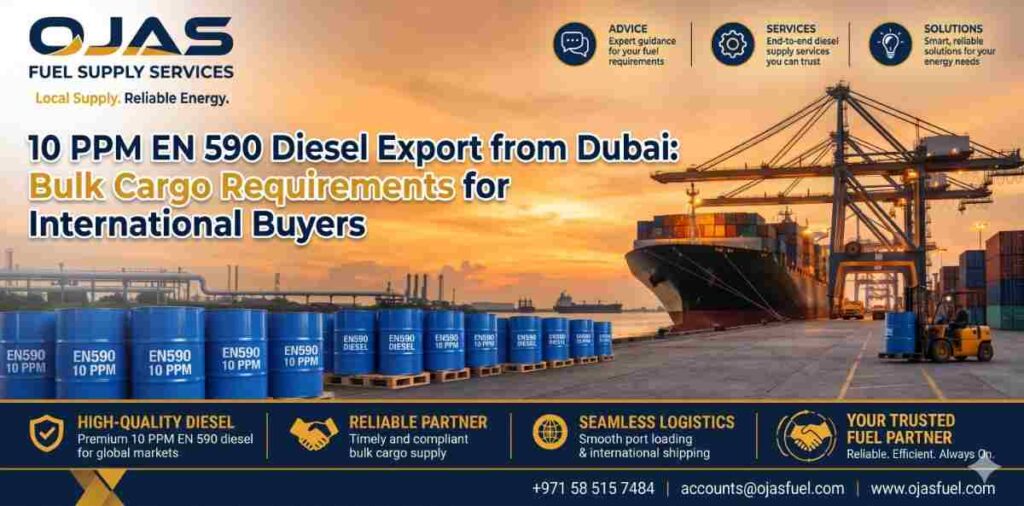
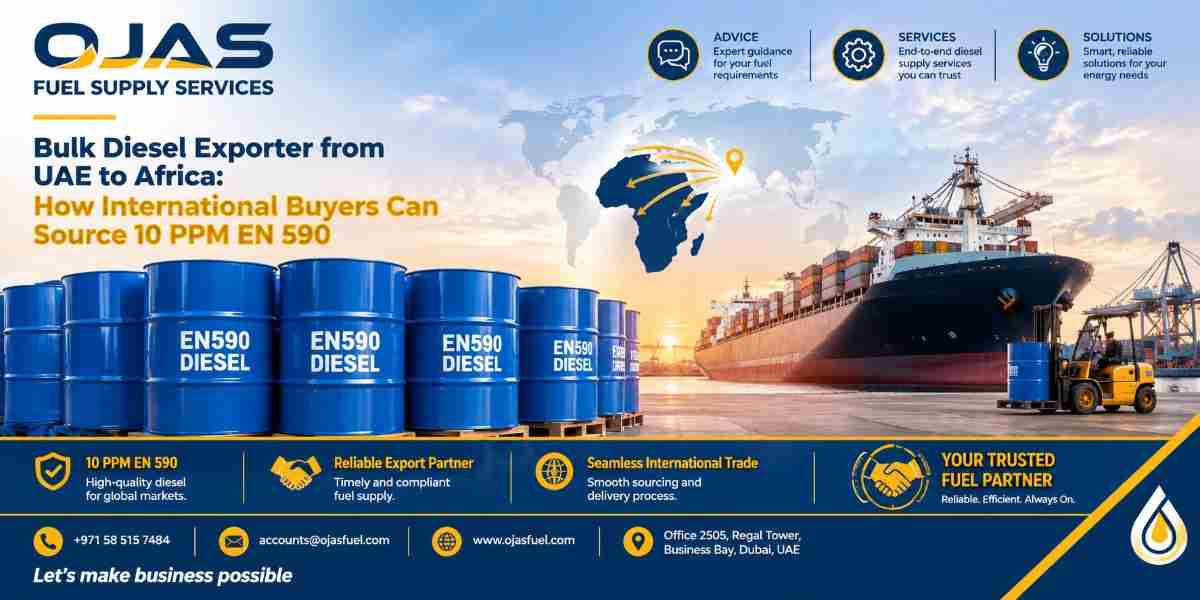
Bulk Diesel Exporter from UAE to Africa: How International Buyers Can Source 10 PPM EN 590
Key Highlights
- UAE-certified 10 PPM EN 590 (UAE.S 477) diesel meets Africa’s AFRI-6 limits and avoids customs rejections tied to outdated 2,000 ppm D2 fuel.
- Loading at Fujairah Port bypasses Strait of Hormuz chokepoints, securing open-ocean export access and MARPOL-compliant MDO bunkering.
- Legal UAE bulk exports require a Federal Law No. 14 of 2017 trading permit, Certificate of Origin, and independent 10 ppm Certificate of Analysis.
- Ministerial Decision No. 229 of 2025 grants 0% corporate tax to qualifying UAE commodity traders, supporting competitive CIF and FOB pricing for African buyers.
The African downstream petroleum sector is undergoing a key transition to harmonize fuel quality and public health standards.
To combat air quality degradation caused by high-sulfur legacy fuels, the African Refiners and Distributors Association (ARDA), alongside the African Union Commission and UNEP, introduced the AFRI-6 standard.
This framework limits the maximum allowable sulfur content in diesel to 10 parts per million (ppm), mirroring European EN 590 specifications.
However, domestic African refining infrastructure faces an estimated $16 billion upgrade backlog to achieve AFRI-6 compliance, creating regulatory fragmentation and supply risks for modern engine fleets calibrated specifically for 10 ppm fuel. Combusting higher-sulfur diesel causes severe engine damage, filter failures, and voided warranties.
Sourcing 10 PPM EN 590 ultra-low-sulphur diesel directly from UAE gateways bypasses local refining bottlenecks. Conforming to the UAE.S 477 standard regulated by the UAE Ministry of Industry and Advanced Technology (MoIAT), UAE exports align with ARDA’s AFRI-6 specifications (ahead of the 2030 continent-wide harmonization target), supporting smooth customs clearance and protecting fleet integrity across Africa.
Keep reading the article to learn more.
Is D2 diesel the same as EN 590 10 ppm diesel?
No, D2 diesel is an outdated legacy standard allowing up to 2,000 ppm sulfur, making it illegal for modern environmental frameworks. EN 590 10 ppm diesel, mandated by the UAE’s ESMA regulations, is a highly refined automotive gas oil (ULSD) essential for modern engines and AFRI-6-equivalent markets.
A persistent and dangerous misconception within informal international petroleum procurement networks is the conflation of the term “D2” with modern ultra-low-sulphur diesel.
Originating from the Soviet-era GOST 305-82 specification, D2 designates a legacy gasoil grade that permits a maximum sulfur concentration of 2,000 ppm.
Conversely, the EN 590 specification restricts sulfur to an absolute maximum of 10 mg/kg (10 ppm).
The structural disparities between these two specifications extend far beyond sulfur content, impacting combustion efficiency, engine safety, and legal trade viability.
| Parameter | Legacy D2 (GOST 305-82) | 10 PPM EN 590 (ESMA UAE.S 477) | Impact on Modern Fleet Operations |
| Sulfur Content | Max 2,000 mg/kg (ppm) | Max 10.0 mg/kg (ppm) | 2,000 ppm causes irreversible DPF poisoning, oil acidification, and illegal emissions levels. |
| Cetane Index | Minimum 45.0 | Minimum 46.0 (Cetane Number 51.0) | EN 590 ensures superior ignition quality, reducing engine knock and optimizing fuel economy. |
| Lubricity (HFRR @ 60°C) | Unregulated / Variable | Max 460 microns | EN 590 requires advanced lubricity additives to protect high-pressure fuel injection systems. |
| Legal Trade Status | Banned for road use in the EU and ECOWAS | Universally accepted (Euro V / AFRI-6) | D2 cargoes will be rejected by African customs authorities enforcing 50 ppm or 10 ppm import caps. |
Any commercial contract or letter of credit referencing “D2” exposes the buyer to massive delivery disputes and compliance failures.
The 1,990 ppm sulfur gap between the two fuels means a D2 cargo cannot legally clear customs in any major regulated market without undergoing expensive and technically complex desulfurization blending at the destination port—a capability rarely available in African import terminals.
For professional diesel trading, international buyers must abandon legacy nomenclature and specifically request 10 PPM EN 590 automotive gas oil.
Sourcing this specification through established UAE channels ensures that the physical product aligns with MoIAT UAE.S 477 requirements, giving buyers verifiable quality documentation to support destination customs clearance and protect modern commercial fleets.
What export documentation is required by Dubai Customs for bulk diesel?
International buyers require a Bill of Entry, a Certificate of Origin, and a Certificate of Analysis (CoA) confirming the 10 ppm specification.
Furthermore, the supplier must hold a valid trading permit under UAE federal regulations to lawfully clear the cargo for export via Jebel Ali Port or Fujairah Port.
Executing a bulk petroleum import/export transaction from the United Arab Emirates requires strict adherence to federal licensing and customs documentation protocols.
The UAE regulates the movement of hydrocarbon derivatives tightly to ensure environmental safety, prevent market speculation, and fulfill international trade obligations.
The foundational legal requirement for any UAE exporter is a valid petroleum trading permit. Under UAE Federal Law No. 14 of 2017 on Trading in Petroleum Products, no natural or legal person may trade, import, or export petroleum products without explicit authorization from the Competent Authority.
The Dubai Supreme Council of Energy acts as the designated authority for enforcing these provisions within Dubai, ensuring that only highly regulated entities can load cargoes.
Attempting to procure bulk diesel from an unlicensed supplier is classified as illegal trading and carries severe penalties, including massive corporate fines and the immediate confiscation of both the petroleum products and the transport vessels involved.
For a cargo to successfully exit UAE territorial waters via Jebel Ali Port or Fujairah Port, the following mandatory documentation checklist must be satisfied through the relevant emirate customs authority (Dubai Customs for Jebel Ali or Fujairah Customs for Fujairah) and the UAE Federal Customs Authority (ICP):
| Document Type | Issuing/Governing Body | Critical Function in Petroleum Export |
| Trading Permit | UAE Competent Authority | Proves the supplier’s legal authorization to export petroleum under Federal Law No. 14 of 2017. |
| Bill of Entry / Export Declaration | Dubai Customs | Officially registers the cargo for physical exit, requiring the exporter to be a registered entity with Dubai Customs. |
| Certificate of Origin (CoO) | Federal Customs Authority / Chambers of Commerce | Validates the geographical origin of the product, essential for applying preferential tariff rates at the African destination. |
| Certificate of Analysis (CoA) | Independent Accredited Laboratory | Verifies that the cargo complies with the UAE.S 477 standard for 10 ppm diesel. Must test density, viscosity, sulfur, and cetane. |
| Safety Data Sheet (SDS) | Supplier / Manufacturer | Must include the UN 1202 classification for gas oil and outline marine pollutant handling instructions. |
FOB vs CIF: Which trade term reduces supply risk for diesel buyers?
Under Incoterms 2020, FOB transfers risk to the buyer once the automotive gas oil is loaded onto the vessel at Jebel Ali Port or Fujairah Port. CIF keeps the seller responsible for freight and insurance until the African destination port, significantly reducing the buyer’s transit risk.
Bulk diesel supply requires precise contractual alignment regarding the allocation of costs, logistical responsibilities, and the exact physical point where cargo risk transfers from the UAE exporter to the African importer.
The International Chamber of Commerce (ICC) Incoterms 2020 framework provides the globally recognized standard for these determinations.
In contemporary petroleum import/export, the choice between FOB (Free On Board) and CIF (Cost, Insurance, and Freight) drastically alters the risk profile of the transaction, especially given the volatility of maritime freight markets.
| Trade Term (Incoterms 2020) | Vessel & Freight Payment | Insurance Responsibility | Exact Point of Risk Transfer | Overall Buyer Risk Profile |
| FOB (Free On Board) | The buyer secures and pays for the vessel charter. | The buyer must arrange their own marine cargo insurance. | When the fuel is loaded on board the vessel (passing the vessel’s permanent manifold flange) at Jebel Ali or Fujairah. | High. The buyer assumes all maritime transit risks, demurrage, and rerouting costs immediately after loading. |
| CIF (Cost, Insurance, Freight) | The seller books and pays for the vessel to the destination. | The seller provides minimum insurance cover for the buyer. | When the fuel passes the vessel’s rail during loading at Jebel Ali or Fujairah. | Moderate. Physical transit risk still transfers to the buyer at loading, and the seller is only required to provide minimum insurance cover (Clause C), though the buyer is shielded from freight rate spikes. |
A critical nuance in the Incoterms 2020 rules for CIF is the decoupling of risk transfer from cost responsibility.
Under CIF, the seller pays for the freight and books the vessel to the named African destination port, but the actual risk of loss passes to the buyer the moment the product is safely loaded on board at the UAE origin port.
However, because the seller manages the logistical execution and absorbs the upfront cost of insurance and freight premiums within the CIF price, the buyer is heavily insulated from sudden logistical shocks.
For buyers without highly developed, institutional-grade marine chartering desks, FOB presents severe operational hazards. Under FOB, the buyer is solely responsible for vessel nomination, managing the Notice of Readiness (NOR), and absorbing demurrage penalties if port congestion delays loading.
In contrast, a CIF arrangement leverages the UAE supplier’s established maritime relationships and local terminal expertise at Jebel Ali and Fujairah, guaranteeing a smoother export clearance process and a highly predictable landed cost.
How do 2026 Strait of Hormuz disruptions affect bulk diesel loading?
The 2026 Strait of Hormuz maritime disruptions have heightened transit risks for Middle East petroleum exports.
However, loading from Fujairah Port provides a strategic advantage, as it sits entirely outside the Strait, offering a secure, uninterrupted export gateway for 10 ppm diesel and Marine Diesel Oil (MDO) bunkering.
The geopolitical landscape of global energy distribution experienced a massive paradigm shift in 2026 due to the severe military escalation and subsequent maritime disruptions in the Middle East.
The Strait of Hormuz, a vital chokepoint that typically facilitates the transit of roughly 20% of the world’s daily oil supply, saw routine commercial operations severely compromised due to targeted attacks and blockades.
This dual blockade, compounded by ongoing hostilities in the Red Sea and the Bab el-Mandeb strait, forced major global shipping lines to suspend operations in the area, stranding vessels at anchorage and heavily reducing Suez Canal transits.
The ripple effects caused immediate spikes in bunker fuel prices, war-risk insurance premiums, and transit times as vessels were forced to reroute around the Cape of Good Hope to reach European and West African markets.
Despite the paralysis inside the Persian Gulf, UAE diesel distribution networks maintain robust export continuity by leveraging specific geographical advantages.
Fujairah Port is structurally immune to the Strait of Hormuz chokepoint. Located on the eastern seaboard of the UAE along the Gulf of Oman, Fujairah operates as a multipurpose maritime hub and the world’s second-largest bunkering port entirely outside the Strait.
This geographical positioning allows international buyers to execute bulk diesel supply operations without subjecting their chartered vessels to the prohibitive insurance premiums and physical dangers associated with entering the Persian Gulf.
While inland pipelines provide an overland bypass moving crude to Fujairah, the ready availability of refined 10 PPM EN 590 diesel directly stored and loaded at Fujairah terminals ensures that clean product exports remain uninterrupted.
By exclusively targeting Jebel Ali Port (for secure intra-Gulf logistics and specific transshipment corridors) and Fujairah Port (for open-ocean export access), buyers establish a highly resilient diesel distribution chain that guarantees supply stability regardless of the volatility inside the Strait of Hormuz.
What documentation is required for Marine Diesel Oil (MDO) bunkering?
Export vessels receiving Marine Diesel Oil (MDO) bunkers at UAE ports must obtain a verifiable Bunker Delivery Note (BDN).
This critical document validates the exact volume and specification of the bunkers, ensuring the receiving vessel strictly complies with international maritime emissions regulations before departing for African waters.
For international fleets managing export routes from the UAE to Europe or Africa, securing compliant marine fuels is as critical as securing the commercial cargo itself.
Marine bunkering operations supplying Marine Diesel Oil (MDO) are strictly governed by international maritime law, specifically MARPOL Annex VI, which dictates rigorous documentation protocols to enforce global sulfur emissions caps.
To ensure safe, legal, and uninterrupted vessel operations post-bunkering, procurement officers must secure the following documentation sequence:
- Verification of Supplier Licensing: Before nominating a barge, the vessel operator must confirm the physical supplier is legally permitted to trade and transfer petroleum under UAE Federal Law No. 14 of 2017. Engaging with unlicensed bunker suppliers risks port state control detention and the legal confiscation of the MDO.
- Pre-Delivery Specification Alignment: The MDO requested must strictly adhere to the ESMA standard specifications to guarantee proper viscosity, lubricity, and sulfur limits. This prevents catastrophic engine or auxiliary unit failure during the ocean voyage. MGO (Marine Gas Oil) is not recognized within this specific supply matrix, MDO serves as the definitive compliant distillate for these bunkering operations.
- Execution of the Bunker Delivery Note (BDN): Upon completion of the physical fuel transfer at Jebel Ali Port or Fujairah Port, the supplier must issue a statutory BDN. According to MARPOL Annex VI regulations, the BDN must record the vessel’s details, the date, the exact quantity of bunkers delivered (subject to the 13,000 Imperial Gallons MOQ), and a formal declaration that the MDO meets the applicable sulfur limits.
- Statutory Document Retention: The receiving vessel’s chief engineer must retain the BDN on board for a minimum of three years for inspection by any port state control authority. Additionally, a representative physical sample of the delivered MDO, sealed and signed by both the supplier and the vessel’s representative, must be kept for at least 12 months.
- Commercial Settlement: Adhering strictly to the standing commercial facts, the financial settlement for the MDO bunkering must be executed via upfront payment, cash on delivery, or Bank Transfer Before Offloading. Failing to align the BDN issuance with these rigid payment sequences will halt the bunkering operation, leading to severe demurrage and delayed departure schedules.
How does Ministerial Decision No. 229 of 2025 impact UAE petroleum trading?
Ministerial Decision No. 229 of 2025 drastically strengthens the UAE’s commodity trading ecosystem by classifying the trading of qualifying commodities, including physical petroleum and structured commodity financing, as a Qualifying Activity.
This grants eligible UAE Free Zone traders a 0% corporate tax rate, sustaining highly competitive pricing for international buyers.
To fully grasp the commercial stability and pricing competitiveness of the UAE bulk diesel export market, international buyers must understand the sophisticated tax and regulatory frameworks governing UAE-based commodity traders.
In recent years, the UAE Ministry of Finance has rapidly modernized its corporate tax infrastructure, ensuring the nation remains the premier global hub for energy distribution and physical commodity trading.
A cornerstone of this framework was the introduction of the Qualifying Free Zone Person (QFZP) regime, initially heavily detailed in 2023, which established a 0% Corporate Tax (CT) rate for entities engaged in specific Qualifying Activities.
To further optimize and expand this ecosystem, the Federal Tax Authority issued Ministerial Decision No. 229 of 2025 (retroactively effective from June 1, 2023).
MD 229 of 2025 explicitly solidifies the “Trading of Qualifying Commodities” including energy commodities like 10 PPM EN 590 diesel as a core Qualifying Activity.
A critical stipulation introduced is that the commodity must possess a “Quoted Price” specified by a recognized commodity exchange or a recognized price reporting agency (such as Platts or Argus Media).
Furthermore, MD 229 broadened the scope of commodity trading to formally include associated structured commodity financing activities (e.g., warehouse receipt financing, export receivable financing) and associated financial derivatives trading used for risk hedging.
However, the updated legislation incorporates a stringent 51% revenue composition test. A UAE trader may forfeit this qualifying status if revenue derived strictly from distribution, warehousing, or logistics functions exceeds 51% of their total revenue for the tax period, ensuring that the primary economic driver remains genuine physical commodity trading.
For African importers, this macroeconomic backdrop is highly advantageous. By operating within an environment that legally shields wholesale petroleum trading and structured financing from high corporate tax burdens, UAE-based suppliers can maintain deep liquidity, secure massive bulk inventory at Fujairah and Jebel Ali, and absorb the high capital requirements of international maritime logistics.
This regulatory stability directly translates to a highly reliable, cost-efficient, and institutional-grade diesel trading market capable of satisfying massive continental demand without pricing friction.
Frequently Asked Questions
1. What is the minimum order quantity for UAE diesel exports from Ojas?
The strict minimum order quantity (MOQ) for 10 PPM EN 590 ultra-low-sulfur diesel and Marine Diesel Oil (MDO) is 13,000 Imperial Gallons (59,099 liters) per order. This exact threshold applies universally across all Africa-bound exports, marine bunkering, and domestic UAE supply services.
2. What payment terms are accepted for international bulk diesel supply from Ojas?
Approved payment terms for international bulk diesel and MDO shipments are limited exclusively to Upfront, Cash on Delivery, or Bank Transfer Before Offloading. No alternative trade credit or delayed financing terms are provided without executive management confirmation.
3. Can UAE suppliers deliver AFRI-6 compliant fuel to Africa?
Yes, UAE-sourced 10 PPM EN 590 diesel mathematically meets and exceeds the AFRI-6 equivalent standard (a strict 10 ppm sulfur limit) required by the African Refiners and Distributors Association (ARDA), supporting fully compliant petroleum import/export operations into African markets.
4. Which UAE ports handle bulk diesel and MDO exports to Africa?
Bulk diesel supply and marine bunkering exports are facilitated exclusively through Jebel Ali Port and Fujairah Port. These specific maritime gateways ensure highly secure loading logistics and proper Dubai Customs export declarations for all Europe and Africa-bound cargoes.
5. Does the export service include Marine Diesel Oil (MDO) bunkering?
Yes, comprehensive marine bunkering services for international export vessels include the direct provision of Marine Diesel Oil (MDO) at Jebel Ali Port and Fujairah Port. All MDO deliveries are accompanied by a fully verified Bunker Delivery Note (BDN) in accordance with strict maritime regulations.
Commercial Inquiries
To secure compliant ESMA-certified 10 PPM EN 590 or Marine Diesel Oil (MDO) for your upcoming shipment, request a commercial quote today.