Diesel Supply
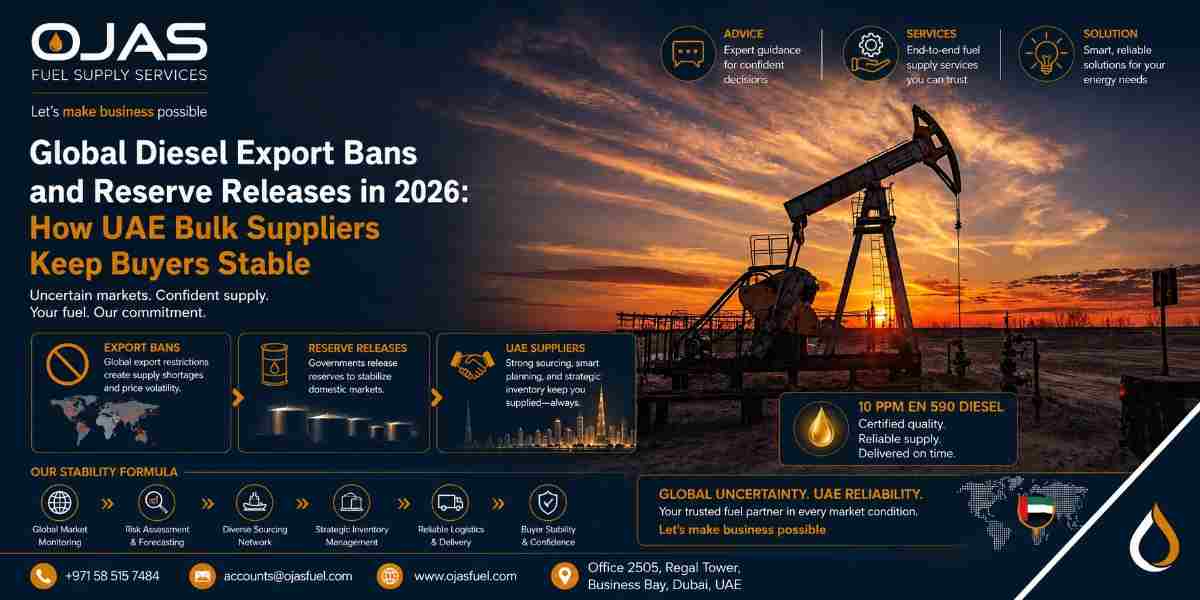
Global Diesel Export Bans and Reserve Releases in 2026: How UAE Bulk Suppliers Keep Buyers Stable
At a Glance
- Russia’s July 2026 diesel export ban remains a major driver of tight global diesel supply, with repeated extensions through 2026.
- The IEA’s March 2026 emergency release, including a 172-million-barrel U.S. drawdown, took about 120 days to fully reach the market.
- OPEC spare production capacity fell to a record-low 320,000 barrels per day in March 2026, reducing the market’s ability to absorb further shocks.
- UAE-loaded 10 PPM Ultra-Low-Sulphur Diesel (EN 590) and Marine Diesel Oil give buyers a contracted sourcing option.
Do Government Reserve Releases Actually Stabilize Diesel Prices?
Reserve releases bring relief, but not instantly.
On March 11, 2026, all 32 IEA member countries agreed to release 400 million barrels of emergency oil and refined products in response to supply disruptions tied to the Iran conflict and severe constraints on Strait of Hormuz transit, the largest coordinated release in the agency’s history.
The action included a 172-million-barrel drawdown from the U.S. Strategic Petroleum Reserve, which officials expected would take about 120 days to fully deliver based on planned discharge rates.
That U.S. reserve stocks had since fallen to 289.7 million barrels, the lowest level since 1982, showing the drawdown was still moving through the system months after it began.
Keep reading the article to learn more.
Why Is Diesel More Expensive in 2026?
Diesel costs climbed in 2026 because a major exporter stopped shipping it.
Russia introduced a diesel export ban on July 8, 2026, citing fuel shortages caused by repeated attacks on domestic refineries, removing a significant volume of global supply and pushing diesel premiums toward multi-year highs.
The ban has been extended multiple times since, most recently on August 25, 2026, when Russia moved to extend the producer-side ban through September, with a separate restriction on diesel and gasoline exports by non-producing companies running through January 31, 2027.
How Does OPEC Spare Capacity Differ From Government Reserve Releases?
These are two different safety nets, and one of them is thinning out.
OPEC spare capacity is production that can be brought online within roughly 30 to 90 days and sustained over time, while emergency reserves are stockpiles drawn down during acute, short-term shocks.
- Spare capacity comes from producers holding back output; reserve releases come from barrels already extracted.
- The IEA reported that OPEC spare production capacity fell to a marginal 320,000 barrels per day in March 2026, the lowest level on record, as Middle East supply disruptions absorbed the buffer.
- A narrower cushion means future shocks lean more on reserve releases, which take months to fully reach the market.
Is UAE-Sourced 10 PPM EN 590 a Reliable Alternative When Russian Supply Is Restricted?
Yes, within a defined role.
As Russian diesel exports stayed restricted through the second half of 2026, buyers across East Africa and the wider Asia-Pacific corridor looked to non-Russian loading points to help fill the gap left by reduced Baltic and Black Sea volumes.
Are UAE Marine Fuel Buyers Also Feeling the Squeeze?
Marine bunkering demand has tightened alongside the broader distillate shortage in 2026.
Fujairah Port is the world’s second-largest bunkering hub after Singapore and sits outside the Strait of Hormuz, a position that has made it a long-standing alternative anchorage during regional supply disruptions.
Buyers should confirm current specifications and request a Certificate of Analysis before contracting.
FOB vs CIF: Which Trade Term Reduces Supply Risk for Diesel Buyers?
The right term depends on how much freight risk you can absorb.
Under ICC Incoterms 2020, FOB (Free On Board) transfers risk to the buyer once cargo loads at Jebel Ali or Fujairah, while CIF (Cost, Insurance, Freight) keeps the seller responsible for freight and insurance until the destination port.
| Trade Term | Risk Transfer Point | Freight Responsibility | Best Suited For |
| FOB (Free On Board) | At loading, Jebel Ali or Fujairah | The buyer arranges and bears freight risk after loading | Buyers with established shipping and logistics networks |
| CIF (Cost, Insurance, Freight) | At destination port | The supplier arranges freight and insurance to the destination. | Buyers seeking reduced exposure during volatile shipping conditions |
CIF typically carries a higher unit cost in exchange for that reduced exposure to shipping volatility. Product availability, pricing, and delivery lead time remain subject to market conditions, product source, destination, and commercial terms agreed upon at the order stage.
What Documentation Do UAE Diesel Importers Need When Supply Is Tight?
The paperwork does not change during a supply crunch, but it is worth reconfirming before you contract.
Petroleum trading in the UAE requires a license under Federal Law No. 14 of 2017, with export and import declarations processed through Dubai Customs and the Federal Customs Authority.
Buyers should also request a Certificate of Analysis for each batch and keep delivery notes on file.
Frequently Asked Questions
- Why did diesel prices spike in 2026?
Russia’s extended diesel export ban, combined with supply disruptions tied to the Iran conflict, tightened global distillate markets through 2026.
Reuters reported that repeated extensions kept exportable volumes off the market, pushing diesel premiums to some of their highest levels in years.
2. Do government reserve releases lower diesel prices immediately?
Not usually. The 172-million-barrel U.S. drawdown tied to the March 2026 IEA-coordinated release was expected to take about 120 days to fully deliver, per Reuters.
Reserve-driven relief reaches the market gradually over several months, not as an instant price fix.
3. Is UAE diesel affected by Russia’s export ban?
Indirectly. UAE-loaded 10 PPM EN 590 cargoes from Jebel Ali have become part of the wider alternative sourcing mix for buyers affected by reduced Russian-origin volumes, though UAE supply has not replaced any single displaced origin at scale.
4. What is the difference between FOB and CIF for diesel cargoes?
Under ICC Incoterms 2020, FOB transfers freight risk to the buyer once cargo loads at the origin port, while CIF keeps the supplier responsible for freight and insurance until the destination port. CIF generally costs more per unit for that reduced exposure.
5. Which UAE ports handle bulk diesel and marine fuel for this route?
This article covers Jebel Ali Port and Fujairah Port, the two UAE gateways relevant to the bulk diesel routes discussed here.
Fujairah also operates as the world’s second-largest bunkering hub, positioned just outside the Strait of Hormuz shipping lane, per the port’s own profile.
6. What license is required to trade diesel in the UAE?
Petroleum trading in the UAE requires a license under Federal Law No. 14 of 2017.
Export and import declarations are processed through Dubai Customs and the Federal Customs Authority, and these licensing requirements apply regardless of current market conditions or supply tightness.
7. Is Marine Diesel Oil affected by the same shortages as EN 590?
Yes. Both distillate products have felt pressure from the 2026 supply disruptions linked to Russia’s export ban and the ongoing Iran conflict, tightening bunker fuel availability at hubs including Fujairah and pushing many suppliers toward firm-enquiry pricing rather than fixed quotes.
Request Current Diesel Trading Terms
Diesel markets in 2026 have shown that policy tools like export bans and reserve releases move slowly and unevenly. A contracted supply relationship gives your operation a defined sourcing path instead of waiting on the next government announcement.
Diesel Trading through Ojas Fuel Supply Services LLC coordinates access to 10 PPM Ultra-Low-Sulphur Diesel (EN 590) loaded out of Jebel Ali Port and Fujairah Port, with FOB and CIF terms structured around your shipping and documentation needs.
Request current pricing to see how a coordinated supply arrangement fits your operational calendar.