
Diesel Supply
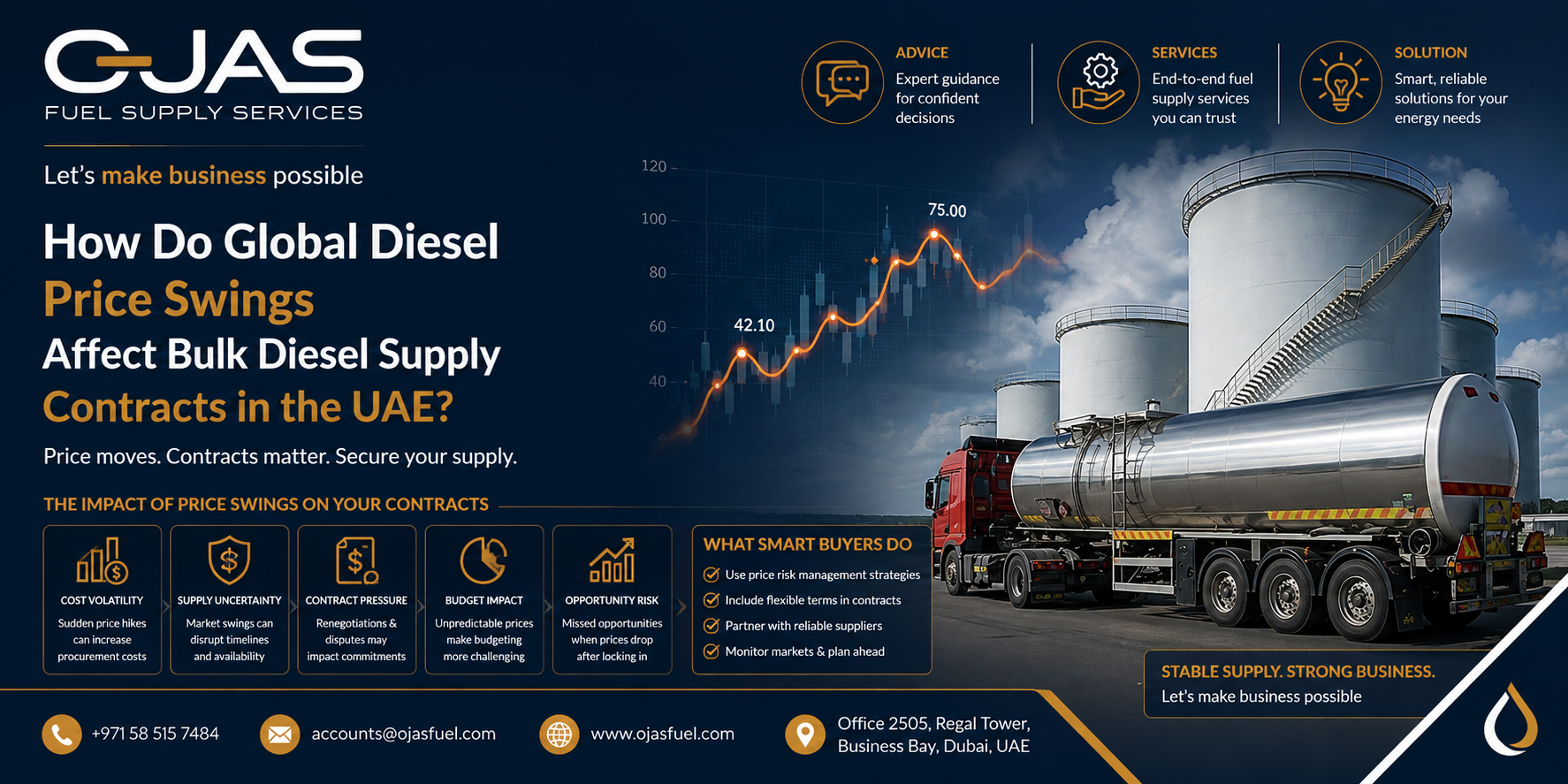
How Do Global Diesel Price Swings Affect Bulk Diesel Supply Contracts in the UAE?
Quick Summary
- Russia’s export ban on diesel and gasoline runs through January 31, 2027, tightening global supply.
- Gulf crude shut-ins peaked near 10.8 million barrels per day in 2026.
- Federal Law No. 14/2017 requires a one-year, renewable Trading Permit for importing or distributing petroleum products in the UAE.
- Fixed-price and index-linked bulk diesel contracts place price risk on different parties.
- Under ICC Incoterms 2020, FOB and CIF shift cost and insurance duty, not risk transfer points.
Diesel prices move sharply because global supply sits tighter than crude oil supply overall.
Russia extended its ban on diesel and gasoline exports through January 31, 2027, per Reuters, removing a major exporter and keeping refined product markets unsettled through 2026.
Three factors drive this volatility:
- Limited refinery capacity for ultra-low-sulphur diesel relative to demand growth.
- Geopolitical export restrictions, including Russia’s extended export ban.
- Disruption at key maritime chokepoints affecting crude feedstock availability.
The U.S. EIA’s Short-Term Energy Outlook estimated Middle East crude shut-ins peaked near 10.8 million barrels per day in 2026, tightening the feedstock refiners rely on to produce diesel.
How Do These Global Swings Reach a UAE Bulk Supply Contract?
Landed diesel cost in the UAE tracks international benchmarks, plus freight, port handling, and compliance costs tied to petroleum trading law.
When a benchmark spikes, an index-linked contract passes that cost through on its next review cycle, while a fixed-price contract holds the agreed rate until the term ends.
A benchmark movement recalculates the landed cost against freight and port charges, and the contract’s pricing mechanism decides when that change reaches the buyer.
Federal Law No. 14/2017 governs the licensed import, distribution, sale, and storage of petroleum products across the UAE, including free zones, and this pricing dynamic falls under Supply Coordination.
Product availability, pricing, and delivery lead time remain subject to market conditions, product source, destination, and commercial terms agreed upon at the order stage.
Fixed-Price vs. Index-Linked Diesel Contracts: Which Protects Buyers Better?
Fixed-price contracts lock a rate for a set term, protecting buyers from short-term spikes but risking above-market pricing if prices fall.
Index-linked contracts track a published benchmark plus a margin, keeping pricing aligned with the market while exposing buyers to swings like the 2026 export restrictions.
| Feature | Fixed-price contract | Index-linked contract |
|---|---|---|
| Price exposure | None during term | Follows benchmark on review cycle |
| Best suited for | Short-term certainty, budget planning | Long-term, high-volume relationships |
| Risk if market falls | The buyer may overpay versus the spot. | Buyer benefits on next review |
| Risk if market spikes | The supplier absorbs cost until term ends | The buyer’s cost rises with the benchmark. |
| Typical term | 1 to 3 months | 6 to 12 months, renewable |
Federal Law No. 14/2017 sets the Trading Permit term at one year, renewable for similar periods, so index-linked contract reviews should align with that renewal cycle.
What Contract Clauses and Incoterms Protect Buyers From Price Volatility?
Price review clauses, volume-tiered pricing, and Incoterm selection determine who carries freight, insurance, and market-timing exposure in a bulk diesel contract.
A price review clause tied to a named benchmark, reviewed monthly or quarterly, reduces disputes when global diesel prices move sharply.
Key clauses to request:
- A price review clause naming the benchmark and revision frequency.
- Volume commitments or tiered pricing based on order size.
- A clear Incoterm choice, most commonly FOB or CIF for seaborne bulk diesel.
- Defined force majeure scope covering supply disruptions.
ICC Incoterms 2020 clarifies that FOB and CIF both transfer risk to the buyer once goods are loaded aboard the vessel at the port of shipment.
The two terms differ in who arranges and pays for freight and insurance, not in when risk passes, so the Incoterm clause needs to be explicit in the contract.
This is a documentation point that Import/Export Facilitation typically addresses before shipment.
Is Bulk Diesel Pricing Regulated by the UAE Government?
Federal Law No. 14/2017 assigns licensing oversight to the Ministry of Energy and Infrastructure and to a Petroleum Products Trading Regulatory Committee in each Emirate, which reviews Trading Permit applications and verifies compliance requirements rather than setting commercial prices.
Bulk commercial diesel contracts are privately negotiated between licensed traders and buyers.
There is no fixed government retail rate for bulk commercial diesel, so the pricing mechanism in your contract, fixed or index-linked, governs your cost exposure.
How Can UAE Buyers Secure Stable Diesel Supply Despite Global Volatility?
Buyers reduce exposure by diversifying supply gateways, matching contract structure to volume and risk tolerance, and working only with traders holding active Trading Permits under Federal Law No. 14/2017.
- Confirm the trader’s Trading Permit is active and matched to the delivery emirate.
- Compare fixed-price and index-linked structures against your volume and budget cycle.
- Request delivery gateways across more than one port, such as Jebel Ali and Fujairah.
- Confirm the Incoterm and price review clause in writing before signing.
Drawing supply from more than one gateway gives buyers a practical hedge against a disruption hitting one corridor harder than another, as happened during the 2026 Strait of Hormuz disruption. This kind of structuring falls under Bulk Supply Planning.
Frequently Asked Questions
- Does a bulk diesel contract price change automatically when global prices spike?
Only if the contract is index-linked to a published benchmark, adjusting on the agreed review cycle. Fixed-price contracts hold the negotiated rate for the full term, shifting short-term volatility risk onto the supplier until renewal.
2. What caused diesel prices to spike in 2026?
Two overlapping shocks tightened supply. Russia’s export ban, extended through January 31, 2027, per Reuters, removed a major exporter, while regional production shut-ins, near 10.8 million barrels per day per the U.S. EIA, tightened crude feedstock for refiners.
3. Can a UAE-licensed trader import diesel without a Trading Permit?
No. Federal Law No. 14/2017 requires any natural or legal person to hold a valid Trading Permit before importing, distributing, selling, or storing diesel anywhere in the UAE, including free zones, or face penalties under its executive regulations.
4. Is Jebel Ali or Fujairah better for a diesel import contract?
Both are established UAE gateways. Jebel Ali suits broader import and distribution reach, while Fujairah’s position on the Gulf of Oman can stay accessible during Strait of Hormuz disruptions.
5. How often should a diesel price review clause be triggered?
Most bulk supply contracts set monthly or bi-weekly price reviews tied to a named benchmark, though frequency depends on volume commitment and appetite for volatility.
Plan a Contract That Fits Your Risk Tolerance
If global diesel benchmarks are making your next bulk order harder to budget for, the right contract structure matters more than timing the market.
Ojas Fuel Supply Services LLC coordinates fixed-price and index-linked bulk diesel arrangements for buyers across GCC, MENA, East, Central, and West Africa; Central Asia; and Asia-Pacific markets, sourced through Jebel Ali and Fujairah gateways.
Our team can walk through both structures against your volume, timeline, and delivery gateway before you commit.