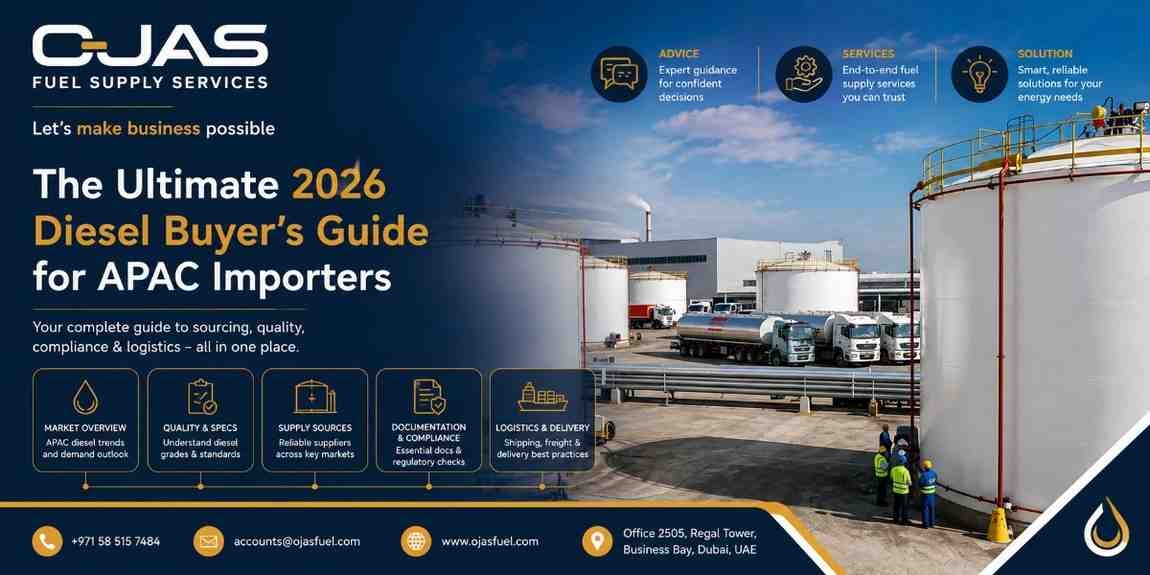
Diesel Supply
The Ultimate 2026 Diesel Buyer’s Guide for APAC Importers
Key Highlights
- 2026’s diesel market shifted from deficit toward a projected late-year surplus, per IEA data.
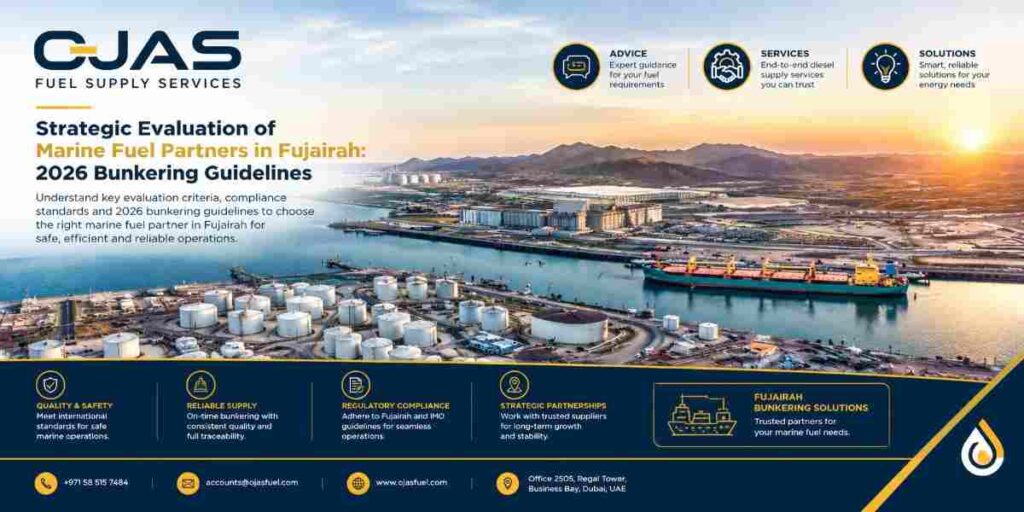
- Fujairah’s ~70 million barrels of storage anchor UAE-to-APAC diesel and MDO supply routes.
- EN 590:2025 and ISO 8217:2024 now set the binding quality specs for ULSD and MDO cargoes.
- Dubai’s Resolution No. 85 of 2025 enforces DSCE permits, with fines up to AED 1,000,000 for violations.
The global energy architecture in 2026 represents a profound departure from the volatile supply constraints that defined petroleum markets throughout 2024 and 2025.
The market swung between deficit and surplus through 2026 as Middle East conflict disruptions and OPEC+ supply decisions repeatedly reshaped the balance.
This fundamental oversupply shifts pricing power from refineries directly into the hands of downstream importers and regional distributors, establishing a macroeconomic environment exceptionally conducive to strategic procurement and long-term contract renegotiations.
Key macroeconomic shifts driving the 2026 landscape include the following:
- Supply Volatility, Recovering Balance: The International Energy Agency’s July 2026 Oil Market Report projects the global oil market swinging back to surplus toward the end of 2026, after a deficit through the second quarter caused by regional supply disruptions.
- Deflationary Price Pressure: Sustained downward pressure is projected across all major upstream crude benchmarks, encompassing Brent, West Texas Intermediate (WTI), and Dubai crude. This cascades directly into structurally suppressed baseline production costs for refined products like Ultra-Low-Sulfur Diesel (ULSD) and Marine Diesel Oil (MDO).
- Robust APAC Demand: The Asia-Pacific (APAC) region continues to function as the undisputed engine for global middle distillate consumption, expanding at a robust rate of 3.1% year-over-year. This growth is heavily concentrated in industrial, infrastructural, and maritime logistics sectors.
- Shifting Regional Supply: China curtailed diesel, gasoline, and jet fuel export allowances from March through June 2026 to protect domestic supply, then began easing those restrictions from July 2026 onward, according to Reuters. Import demand patterns across Southeast Asia continue to shift alongside these swings.
For the APAC diesel importer operating in 2026, this dichotomy demands a highly sophisticated procurement approach.
Buyers must leverage the global surplus to negotiate favorable index-linked pricing while seamlessly navigating complex supply chain logistics, strictly enforcing evolving quality assurance parameters, and ensuring absolute compliance with regulatory frameworks.
At OJAS Fuel Supply Services, our operating model is built to coordinate this exact continuity with clarity, discipline, and commercial control.
Moving the Fuel: Strategic Port Gateways and Tanker Freight Economics
The physical movement of refined petroleum products from the Middle East Gulf (MEG) to APAC consumption centers relies entirely upon the infrastructural integrity of key maritime energy gateways.
The United Arab Emirates (UAE) has solidified its position as a non-replicable logistical node for this trade route, anchored by Jebel Ali Port, Fujairah Port, Hamriyah Port, and Khalifa Port.
1. Why Fujairah (FOIZ) is Your Safest Bet for Storage and Transit
Among these critical infrastructural nodes, the Fujairah Oil Industry Zone (FOIZ) represents the single most vital balancing point for global energy flows, physical trading strategies, and bulk liquid storage.
Key operational advantages of FOIZ include:
- Geopolitical Security: Occupying 12.8 million square meters on the eastern seaboard of the UAE, FOIZ provides uninterrupted access to the Indian Ocean, entirely bypassing the geopolitically sensitive Strait of Hormuz.
- Reduced Transit Risk: By circumventing the Strait, maritime vessels benefit from significantly reduced voyage times to Asian destination ports and deeply mitigated exposure to regional military conflicts.
- Massive Storage Scale: FOIZ hosts the region’s largest commercial storage capacity dedicated to refined petroleum products, totaling approximately 70 million barrels distributed across 366 specialized storage tanks and 18 operational terminals managed by premier entities.
- Supply Redundancy: The systemic resilience of Fujairah is guaranteed by the Abu Dhabi Crude Oil Pipeline (ADCOP), a 370-kilometer infrastructure capable of transporting up to 1.5 million barrels per day directly from onshore fields to Fujairah export terminals.
2. Choosing the Right Tanker: Freight Economics from the Middle East to Asia
The economic viability of transporting middle distillates from the Middle East to the Asia-Pacific is dictated by the strategic deployment of specific vessel classes:
| Vessel Classification | Approximate Capacity (DWT) | Primary Route Utilization | Strategic Operational Profile |
| Medium Range (MR) | 35,000 – 55,000 | Intra-Asia, Short-haul MEG | Acts as the foundational workhorse for regional trade. Offers superior operational flexibility due to shallow draft requirements, enabling discharge at highly restricted APAC ports without lightering. |
| Long Range 1 (LR1) | 55,000 – 80,000 | MEG to Singapore/China | Strikes a balance between bulk volume efficiencies and port accessibility. Frequently utilized for standard arbitrage routes where MRs are cost-prohibitive but LR2s cannot berth. |
| Long Range 2 (LR2) | 80,000 – 120,000 | Long-haul MEG to major APAC hubs | Provides the absolute lowest per-barrel freight cost over long distances due to massive economies of scale, though deep-draft requirements restrict discharge strictly to major deep-water terminals. |
3. CIF vs. FOB: Which Incoterm Protects Your Bottom Line?
The selection between Cost, Insurance, and Freight (CIF) and Free On Board (FOB) is a profound financial decision dictating the allocation of maritime risk.
- FOB (Free On Board): Under FOB terms, the seller fulfills their delivery obligation the moment the liquid cargo passes the ship’s rail at the designated port of loading. The APAC buyer assumes all subsequent responsibilities, risks, and costs, heavily exposing the buyer to origin-port risks like load-port demurrage.
- CIF (Cost, Insurance, and Freight): Conversely, under CIF terms, the seller arranges, finances, and manages the maritime transport and insurance to the named destination port. CIF provides the buyer with immense logistical convenience and cost predictability, effectively outsourcing volatile freight and insurance procurement processes to the supplier.
Protecting Your Engines: Non-Negotiable Diesel Quality Specs
Procurement in the international diesel market requires an unyielding adherence to international chemical and physical specifications.
The two dominant specifications governing APAC imports are EN590 for automotive/industrial use and ISO 8217:2024 for marine propulsion.
EN590 ULSD 10 PPM: The Gold Standard for Automotive Diesel
The EN 590:2025 standard, which supersedes EN 590:2022, sets the current parameters for automotive diesel fuel. The 10 PPM sulfur limit ensures strict compatibility with modern emission control architectures. Beyond sulfur, structural integrity relies on several critical metrics:
- Cetane Number: A minimum of 51.0 ensures optimal, rapid combustion efficiency and drastically curtails cold-start emissions.
- Lubricity: To prevent catastrophic abrasive wear in high-pressure fuel pumps, the High-Frequency Reciprocating Rig (HFRR) wear scar diameter must not exceed 460 microns.
- Cold Filter Plugging Point (CFPP): This must align with the destination market’s specific seasonal climate (e.g., summer grade maximum +5°C and winter grade maximum -15°C) to prevent instantly clogged fuel filters.
2. ISO 8217:2024: The New Rules for Marine Diesel Oil (MDO)
The ISO 8217:2024 standard represented a massive paradigm shift in marine fuel classification to accommodate the maritime industry’s aggressive decarbonization efforts. For marine distillates (DMA and DMB grades), critical updates must be aggressively managed:
- Flash Point Restrictions: Unlike automotive diesel, marine fuels are subject to the strict governance of SOLAS, which unequivocally mandates an absolute minimum flash point of 60.0 C to prevent shipboard fires.
- FAME Content Allowances: The 2024 update radically altered the treatment of Fatty Acid Methyl Ester (FAME) content, removing historical caps but introducing rigorous new testing parameters, including mandatory reporting of the net heat of combustion and vastly enhanced oxidation stability requirements.
- Density Controls: Density for DMA grade cannot exceed 890.0 kg/m³ at 15°C to ensure the operational efficiency of onboard centrifugal purifiers.
To mitigate the extreme financial risk of receiving off-specification cargo, independent quality verification via a Certificate of Analysis (COA) issued by internationally recognized third-party inspection agencies at both load and discharge ports is non-negotiable.
Price Discovery and Hedging Strategies
Price discovery in the APAC physical petroleum market is entirely tethered to independent indexing, with the Mean of Platts Singapore (MOPS) serving as the universal benchmark.
1. Understanding MOPS: The Benchmark That Drives Your Price
MOPS represents the mathematical average of a set of Singapore-based physical price assessments (FOB Straits) determined 15 to 30 days forward.
Commercial supply contracts are universally structured as an agreed-upon premium or discount applied directly to this floating MOPS benchmark.
2. Smart Hedging: Using Crack Spreads and Average Price Options
Because buyers are exposed to massive flat-price risk between procurement and retail distribution, they must utilize complex financial derivatives:
- Gasoil Crack Spreads: Traded on exchanges like ICE, this allows importers to financially lock in the precise refining margin between a raw barrel of crude oil and the refined middle distillate product.
- Average Price Options (APOs): These options provide asymmetric downside protection, establishing a hard mathematical ceiling on procurement costs while retaining flexibility to capitalize on spot market price collapses.
Bulletproof Contracts: Trade Finance and B2B Agreements
The safe execution of international petroleum transactions relies heavily upon robust trade finance mechanisms and bulletproof contracting.
The primary financial instrument utilized for spot market transactions is the Documentary Letter of Credit (DLC), governed by the ICC’s UCP 600.
Critical UCP 600 regulations include the following:
- Article 20: Dictates that a Bill of Lading must clearly indicate the goods have been “shipped on board” a named vessel, protecting against cargo loss.
- Article 27: Requires the presentation of a “clean transport document” bearing absolutely no clause expressly declaring a defective condition of the goods.
For recurring multi-cargo supply agreements, corporate buyers frequently deploy Standby Letters of Credit (SBLCs).
An SBLC functions as a secondary guarantee mechanism triggered only if the buyer explicitly defaults on a standard wire transfer invoice payment, vastly improving corporate liquidity.
The OJAS Standard: Doing Business Safely and Responsibly
The macroeconomic surplus of 2026 offers immense commercial opportunity, but capturing this value requires an operating model built on extreme discipline.
At OJAS Fuel Supply Services, our commercial value extends beyond the fuel itself; we provide dependable energy access through controlled commercial supply coordination.
Our operating guardrails are non-negotiable tenets for responsible execution:
- No Unclear Product Specifications: Commercial negotiations mandate absolute adherence to the current EN 590:2025 or ISO 8217:2024 standards.
- No Informal Commercial Commitments: Transactions must be structured and documented flawlessly from the first Irrevocable Corporate Purchase Order (ICPO) to the final Sales and Purchase Agreement (SPA).
- No Unsupported Documentation Claims: We enforce clear handling of quotations, invoices, supply records, and trade documents, demanding proof of tank terminal access and historical past performance.
- No Compromise on Safety-Sensitive Coordination: All operations must align strictly with regulatory, environmental, and security frameworks.
Staying Legal in Dubai: Resolution No. 85 of 2025
For APAC importers sourcing product directly from, or transiting cargo through, the emirate of Dubai, unwavering compliance with local regulatory frameworks is mandatory. In late 2025, Dubai aggressively implemented Executive Council Resolution No. (85) of 2025 to strictly regulate dealing in petroleum products.
The Dubai Supreme Council of Energy (DSCE) serves as the primary oversight authority. The law dictates that absolutely no entity may engage in the import, distribution, transport, sale, or storage of petroleum products without a specific permit issued by the DSCE, and all handled products must be procured exclusively from a DSCE-approved company.
Entities must also be fully registered in the Petroleum Trading Register maintained by the UAE Ministry of Energy and Infrastructure. The resolution mandates severe administrative fines for non-compliance, capped at a staggering AED 1,000,000:
| Violation Category | Specific Offense under Resolution No. (85) of 2025 | Administrative Fine (AED) |
| Licensing & Permits | Selling, purchasing, transporting, or distributing diesel without a valid DSCE permit. | 25,000 |
| Product Integrity | Dealing in diesel that does not conform strictly to SCE-approved technical standards. | 50,000 |
| Chain of Custody | Acquiring diesel from unknown, unverified, or unauthorized sources outside the approved network. | 25,000 |
| Operational Control | Dealing in petroleum products in unapproved locations or unauthorized geographic areas. | 50,000 |
| Regulatory Obstruction | Obstructing SCE employees, denying access to operational records, or refusing product sampling. | 25,000 |
APAC buyers contracting FOB cargoes out of Dubai must ensure their local shipping agents, storage terminal operators, and suppliers are fully licensed under this DSCE framework and the Security Industry Regulatory Authority (SIRA), which mandates specialized Tanker Berth Safe Work Permits.
By anchoring procurement strategies in deep macroeconomic foresight, leveraging the unmatched infrastructural supremacy of gateways like Fujairah, and adhering to uncompromising quality and strict UAE regulatory guardrails, the Asia-Pacific importer can successfully and profitably navigate the extreme complexities of the 2026 global diesel market with a trusted partner like OJAS Fuel Supply Services.