
Diesel Supply
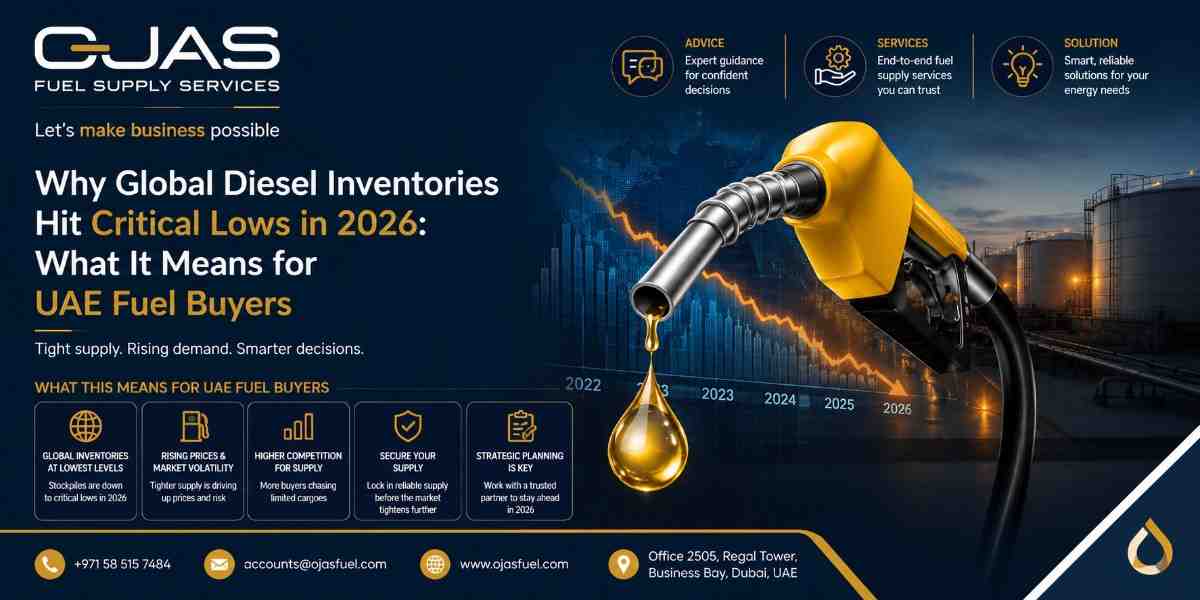
Why Global Diesel Inventories Hit Critical Lows in 2026: What It Means for UAE Fuel Buyers
Summary
- Strait of Hormuz disruptions since late February 2026 and Russia’s export ban, extended through January 2027, tightened global diesel supply, per the IEA and Reuters.
- Fujairah’s diesel-linked stocks dipped in early July 2026 but have since climbed to their highest level in months, per Fujairah Oil Industry Zone data.
- Jebel Ali and Fujairah sit near the Hormuz corridor, exposing cargo to scheduling risk.
- ESMA’s UAE.S 477 standard still caps sulphur at 10 PPM for Ultra-Low-Sulphur Diesel, even during supply pressure.
- Fixed-term supply arrangements can reduce your exposure to spot-market price swings.
Global diesel inventories fell sharply in 2026 after the Strait of Hormuz effectively closed to commercial shipping from late February, cutting Middle East refined-product flows, per the International Energy Agency.
Russia added further pressure, banning diesel exports from July 8, 2026, then extending that ban through January 31, 2027, Reuters reported.
Russia introduced the ban to stabilize its domestic market after repeated drone attacks on refineries.
The July 30, 2026 extension covers diesel, gasoline, marine fuel, and gas oils through January 2027, though producers’ own exports of diesel, marine fuel, and gas oils become exempt from September 1, 2026, per Reuters.
That carve-out could ease supply later this year, but the broader restriction stays in force.
How Does the Strait of Hormuz Disruption Affect Diesel Supply Through UAE Ports?
Jebel Ali and Fujairah sit close to the Hormuz corridor, so regional disruptions directly affect vessel scheduling, freight costs, and cargo availability for diesel and MDO import and export through these gateways.
Fujairah operates as a bunkering and trading hub just outside the strait, which has kept it central to the region’s supply picture through 2026.
Practical effects for buyers moving product through these ports include:
- Vessel scheduling delays as tankers reroute or await war-risk clearance.
- Freight and insurance surcharges tied to elevated regional risk premiums.
- Intermittent cargo scarcity when Hormuz transit volumes tighten, per IEA reporting.
Is Fujairah’s Diesel Supply Recovering in 2026?
Fujairah’s middle distillate stocks, the category covering diesel and jet fuel, dipped in early July 2026 but have since climbed to their highest monthly average in months, per Fujairah Oil Industry Zone (FOIZ) data.
Supply stays sensitive to Hormuz-related disruption even as this category has strengthened.
| Period | Fujairah middle distillate stock (diesel and jet fuel) | Change |
| June 2026 average | 1.35 million barrels | Up 187,000 barrels, about 16% versus May |
| Week to July 6, 2026 | 1.235 million barrels | Down 18%, first weekly drop in six weeks |
| August 2026 (month to date) | 1.50 million barrels | Up 119,000 barrels, about 9% versus July |
Fujairah’s heavy distillate and residual fuel oil stocks, which mainly reflect bunker fuel oil rather than diesel or MDO, moved the opposite way, falling 35% month to date in August to 3.60 million barrels after a three-month high in early July, per FOIZ data.
This divergence is why diesel buyers should track middle distillate figures directly rather than the total port stock headline.
Should You Lock In Diesel Supply Contracts Now?
With diesel inventories below seasonal norms globally and Hormuz-linked disruption risk flagged as ongoing in the IEA’s August 2026 Oil Market Report, buyers exposed to spot volatility may benefit from fixed-term supply arrangements that hedge against further price swings.
The right choice depends on your consumption volume and risk tolerance.
| Approach | Advantage | Trade-off |
| Spot purchase | Flexibility to buy only when needed | Full exposure to price spikes during shocks |
| Fixed-term Supply Coordination | Price and volume predictability over the term | Less flexibility to capture a market dip |
Product availability, pricing, and delivery lead time remain subject to market conditions, product source, destination, and commercial terms agreed upon at the order stage.
What Specifications Should You Confirm During a Supply Crunch?
During supply squeezes, confirm compliance with the 10 PPM sulphur cap for Ultra-Low-Sulphur Diesel under ESMA’s UAE.S 477 standard, regardless of sourcing pressure elsewhere.
Cutting corners on specification checks during a shortage raises engine and warranty risk.
Before accepting any diesel or MDO cargo, request:
- A current specification sheet referencing EN 590 or the applicable MDO grade.
- A Certificate of Analysis for the specific batch supplied.
- A cargo inspection report aligned with Dubai Customs or Federal Customs Authority requirements.
How Do Incoterms Affect Diesel Contracts During Supply Volatility?
Incoterms 2020, published by the International Chamber of Commerce, define where risk and cost transfer between buyer and seller during shipment, which matters more when freight and war-risk surcharges move quickly.
FOB and CIF shift responsibility for freight, insurance, and risk at different voyage points.
Confirming which Incoterm applies before you sign avoids disputes over who absorbs a mid-voyage cost spike tied to Hormuz-related disruption.
Also Read: What Incoterms Should You Use When Buying Diesel from a UAE Exporter?
Frequently Asked Questions
- Why did global diesel inventories drop so much in 2026?
Strait of Hormuz disruptions from late February 2026 cut Middle East refined-product exports, and Russia’s export ban, extended through January 2027, removed further supply, tightening inventories worldwide, per IEA and Reuters reporting.
2. Are UAE diesel supplies affected by the Hormuz disruption?
Yes. Jebel Ali and Fujairah sit near the corridor, so vessel delays and cargo scarcity from regional disruption have influenced availability at these gateways during 2026.
3. Is Fujairah’s diesel stock recovering in 2026?
Yes. FOIZ data show middle distillate stocks dipped 18% in the week to July 6, then rose to a monthly average of 1.50 million barrels in August, about 9% above July.
4. Is Russia’s diesel export ban still in effect?
Yes. Russia extended it through January 31, 2027, on July 30, 2026, though producers’ own exports of diesel, marine fuel, and gas oils became exempt from September 1, 2026, per Reuters.
5. Should I fix diesel prices now or buy spot?
It depends on your risk tolerance and volume. Given uncertainty flagged in the IEA’s August 2026 report, a fixed-term Supply Coordination agreement can reduce exposure to further price swings.
6. What sulfur limit applies to UAE diesel?
ESMA’s UAE.S 477 standard caps sulfur content at 10 PPM, aligned with EN 590, and this does not change during supply shortages.
Request Current Pricing and Supply Terms
Diesel and MDO markets remain volatile through the rest of 2026, shaped by ongoing Strait of Hormuz disruption and Russia’s extended export restrictions.
If your operation depends on consistent diesel or MDO access through Jebel Ali, Fujairah, Hamriyah, or Khalifa Port, waiting for stability is not a plan.
Ojas Fuel Supply Services LLC coordinates 10 PPM Ultra-Low-Sulphur Diesel (EN 590) and Marine Diesel Oil (MDO) supply arrangements for construction, logistics, marine, industrial, power generation, and export-buyer clients across the GCC, MENA, and Africa.
Through its Diesel Trading service, request current market-linked pricing, weigh fixed-term versus spot options, and confirm documentation before committing to volume.