
Ojas Fuel
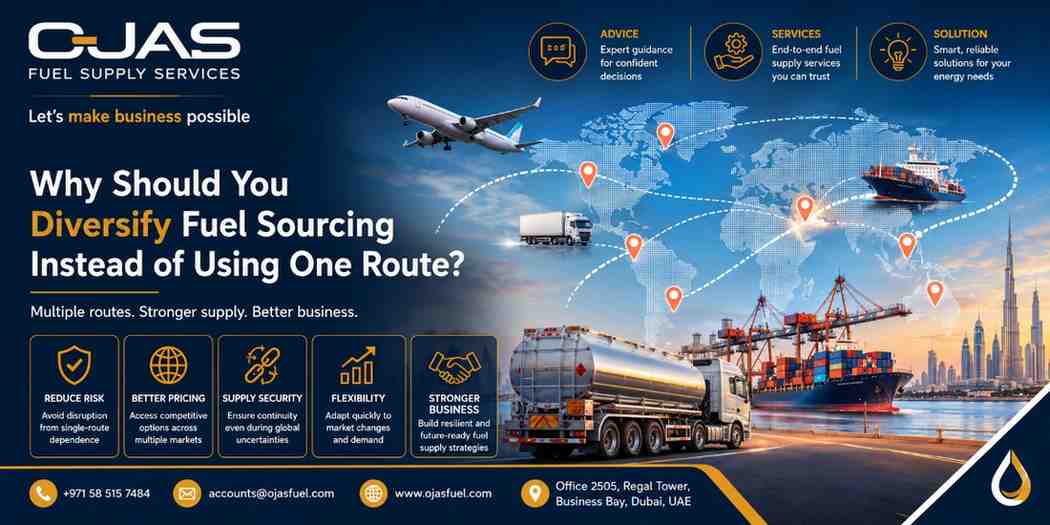
Why Should You Diversify Fuel Sourcing Instead of Using One Route?
Quick Summary
- One sourcing route can concentrate your exposure to export restrictions, shipping disruption, and supplier capacity constraints.
- The International Energy Agency described the March 2026 Middle East conflict as the largest supply disruption in oil-market history.
- Jebel Ali and Fujairah provide distinct UAE gateway options for coordinated supply planning.
- FOB and CIF both transfer risk when cargo is loaded on board, but freight and insurance responsibilities differ.
- Route-specific documentation, including a Certificate of Analysis, supports traceability for each shipment.
You reduce dependence on a single export policy, shipping lane, and supplier capacity when you arrange fuel supply through more than one route.
If one route is disrupted, an alternative arrangement may support continuity. Diversification does not remove market risk, but it avoids concentrating all exposure in one supply path.
The International Energy Agency reported in March 2026 that the Middle East conflict was creating the largest supply disruption in the history of the global oil market.
This is a specific example of why a single-route plan can create operational exposure. You can use Import/Export Facilitation to coordinate supply arrangements across confirmed UAE gateways.
How Can Strait of Hormuz Disruption Affect Your Diesel Planning?
The Strait of Hormuz disruption that intensified in late February 2026 affected a route that had carried close to 20 million barrels of oil per day before the conflict.
The International Energy Agency reported that flows through the Strait fell to a trickle during the disruption. If your planned route depends on this area, you should assess alternative gateway arrangements before you commit to shipment timing.
Reuters reported that U.S. ultra-low-sulphur diesel futures settled 11.6% higher at $154.71 a barrel on July 8, 2026, after Russia announced a diesel export ban. The movement illustrates how a supply shock can affect diesel benchmarks used in commercial negotiations.
Product availability, pricing, and delivery lead time remain subject to market conditions, product source, destination, and commercial terms agreed upon at the order stage.
Why Do Export Restrictions Matter to Your EN 590 Purchase?
Russia extended restrictions on diesel and gasoline exports through January 31, 2027, according to Reuters on July 30, 2026.
A change in a major exporting market can affect the wider price environment even when your shipment is coordinated from the UAE.
You should therefore review the route, product specification, and contract terms together rather than treating them as separate decisions.
For your 10 PPM Ultra-Low-Sulphur Diesel (EN 590) purchase, market context should not be mistaken for a statement about a particular product’s origin.
Your commercial arrangement should state the applicable specification, quantity, shipment terms, and documents for the individual order. Diesel Trading can support the coordination of these commercial requirements.
How Do Jebel Ali and Fujairah Support Route Planning?
Jebel Ali and Fujairah provide two different UAE gateway options for supply coordination. The Port of Fujairah states that it is on the UAE east coast and approximately 70 nautical miles from the Strait of Hormuz.
Using more than one gateway in your planning can reduce dependence on a single route profile.
| Factor | Jebel Ali | Fujairah |
| Route profile | UAE west-coast gateway | UAE east-coast gateway |
| Planning use | Regional logistics and re-export coordination | Energy and marine supply coordination |
| Relevant products | 10 PPM Ultra-Low-Sulphur Diesel (EN 590) | Marine Diesel Oil (MDO) and 10 PPM Ultra-Low-Sulphur Diesel (EN 590) |
| Diversification purpose | Reduces reliance on one gateway | Adds a separate gateway option |
Your gateway selection should reflect the destination, vessel or land logistics, product requirements, and agreed commercial terms.
Bulk Supply Planning can coordinate a volume plan across Jebel Ali and Fujairah, while Marine Fuel Coordination can support MDO requirements linked to marine operations.
Should You Use FOB or CIF for Route Flexibility?
FOB and CIF can both be used for sea shipments, but they allocate responsibilities differently.
Under Incoterms 2020, risk transfers from seller to buyer when the goods are on board the vessel at the named port of shipment under both FOB and CIF.
You should select the term that matches the level of transport control and administrative responsibility you can manage.
| Factor | FOB | CIF |
| Risk transfer | When cargo is on board at the port of shipment | When cargo is on board at the port of shipment |
| Main carriage arranged by | You | Seller |
| Insurance arranged by | You | The seller provides the required cover under the term |
| Route selection | You nominate the vessel and route | The seller arranges carriage to the named destination port |
| Planning use | When you need direct carrier and routing control | When you prefer seller-arranged freight and insurance |
FOB may give you more control over the carrier and route after loading. CIF may simplify freight arrangements, but you should verify the insurance scope, destination, and document requirements in the sale contract.
Import/Export Facilitation can help you coordinate Incoterms, shipment documents, and gateway requirements.
What Documents Support Traceable Diesel and MDO Supply?
You should request a Certificate of Analysis for each batch, together with shipment-specific quantity and delivery records.
For import or export movements, retain customs documents that identify the relevant route and consignment. Keeping records by shipment and gateway makes it easier to review what was arranged for each order.
Federal Law No. 14 of 2017 regulates petroleum products trading in the UAE. The law requires a Trading Permit for petroleum products trading and prohibits the sale or supply of petroleum products that do not meet approved standard specifications.
Your documentation review should therefore confirm the product description, agreed specification, and route records for each shipment.
How Can You Start a Multi-Route Supply Plan?
Start by defining the required volume, product, destination, and delivery window for each order.
Then identify whether Jebel Ali, Fujairah, or a split arrangement suits your route and logistics requirements. This allows you to evaluate continuity planning before you finalize a commercial term.
Next, decide whether FOB or CIF gives you the appropriate level of control over freight and insurance.
Request a Certificate of Analysis and shipment-specific documentation as part of the order process.
Bulk Supply Planning can coordinate these steps for 10 PPM Ultra-Low-Sulphur Diesel (EN 590) and Marine Diesel Oil (MDO).
Frequently Asked Questions
1. Why does one diesel sourcing region increase risk?
One sourcing region can concentrate your exposure to one export policy, shipping route, and supplier network.
If that route is disrupted or the exporting market restricts supply, you may have fewer immediate alternatives. Planning across more than one gateway can reduce this concentration, although it cannot eliminate market or contractual risk.
2. Is Fujairah outside the Strait of Hormuz?
The Port of Fujairah describes itself as located on the UAE east coast, approximately 70 nautical miles from the Strait of Hormuz. This gives Fujairah a route profile distinct from UAE west-coast gateways.
Your final routing decision should still consider the destination, shipping availability, product source, and applicable commercial terms.
3. Is FOB or CIF better for diversifying diesel sourcing?
FOB may suit you when you need to nominate the vessel and manage the main carriage after loading.
CIF may suit you when you want the seller to arrange freight and the insurance required under the term. Both terms transfer risk when cargo is on board, so the contract details remain important.
4. What should you request with a diesel or MDO shipment?
Request a Certificate of Analysis for the batch, quantity, and delivery records and customs documentation where the shipment involves import or export procedures.
The order documents should identify the product, agreed specification, commercial term, and relevant gateway. Review each shipment separately rather than relying on a general document set.
5. Do export restrictions affect UAE diesel buyers?
Export restrictions in major producing markets can affect global diesel availability and benchmark pricing. Reuters reported that Russia extended diesel and gasoline export restrictions through January 31, 2027.
You should assess market conditions when confirming timing, commercial terms, and alternative routing options for your order.
6. How do you begin coordinating supply across two gateways?
Define the product, volume, destination, and delivery requirement first. Then compare whether one gateway or a split between Jebel Ali and Fujairah fits the shipment route and logistics plan.
A supply coordinator can help align gateway selection, Incoterms, product documentation, and shipment records before an order is finalized.
Plan Your Fuel Supply Across Confirmed UAE Gateways
If your operations need 10 PPM Ultra-Low-Sulphur Diesel (EN 590) or Marine Diesel Oil (MDO), you can arrange a supply discussion around your required volume, destination, preferred gateway, and delivery window.
Ojas Fuel Supply Services coordinates Bulk Supply Planning across Jebel Ali and Fujairah, with Import/Export Facilitation and Marine Fuel Coordination where the order requires these services.
Provide the product, volume, destination, preferred Incoterm, and any gateway preference when requesting a quote. This allows the supply arrangement and documents to be reviewed against the specific order requirements.
Product availability, pricing, and delivery lead time remain subject to market conditions, product source, destination, and commercial terms agreed upon at the order stage.