Diesel Supply
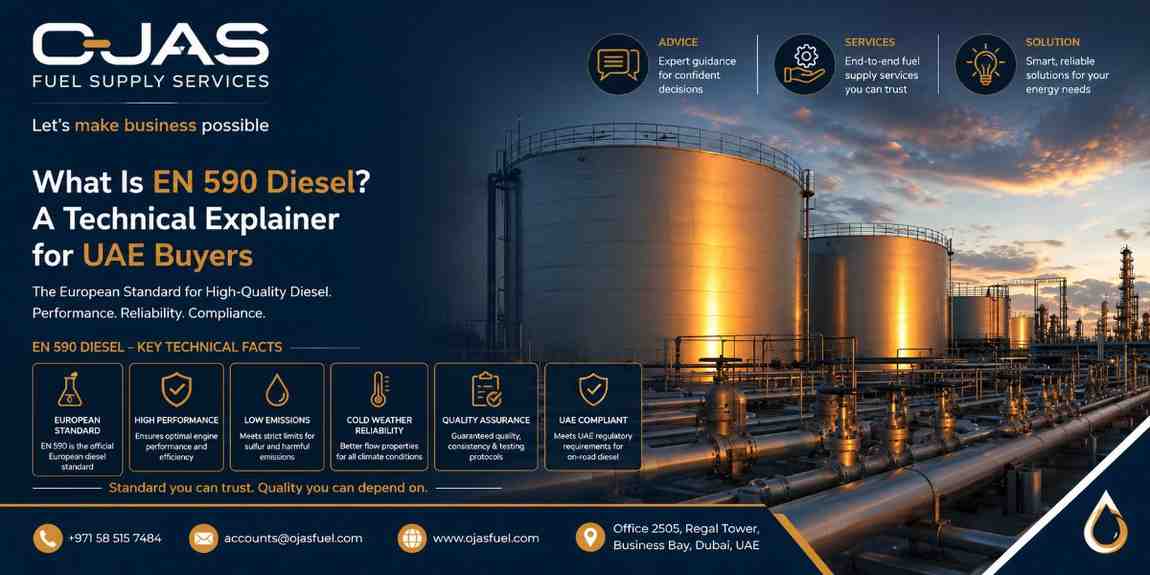
What Is EN 590 Diesel? A Technical Explainer for UAE Buyers
Quick Summary
- EN 590 caps sulfur content at 10 mg/kg, making it the reference standard for 10 PPM Ultra-Low-Sulfur Diesel (EN 590).
- The minimum cetane number is 51.0, density must sit between 820 and 845 kg per cubic meter at 15°C, and flash point must reach at least 55°C.
- A Certificate of Analysis, Certificate of Origin, and inspection report together confirm specification compliance before delivery.
- Federal Law No. 14 of 2017 requires a valid Trading Permit for anyone moving petroleum products, including diesel, through UAE territory.
- Jebel Ali Port and Fujairah Port are the two confirmed gateways supporting diesel supply coordination across the UAE.
EN 590 is the technical specification for automotive diesel fuel, setting a maximum sulfur limit of 10 mg/kg along with minimum thresholds for cetane number, density, and flash point.
In the UAE, this grade is coordinated as 10 PPM Ultra-Low-Sulphur Diesel (EN 590), checked against these same thresholds before it reaches fleets, generators, and industrial buyers.
In July 2014, a cabinet decree, together with updated guidelines from the Emirates Authority for Standardization and Metrology, made 10 ppm sulfur diesel mandatory across the UAE, replacing the previous 500 ppm sulfur limit, according to the UAE Government’s official portal.
This change brought UAE diesel sulfur limits in line with Euro 5-equivalent standards, matching the same 10 mg/kg ceiling used in the EN 590 specification.
Buyers sourcing 10 PPM diesel for construction, logistics, or power generation use should confirm that any supply contract references this exact specification rather than a generic “low-sulphur” label.
Product availability, pricing, and delivery lead time remain subject to market conditions, product source, destination, and commercial terms agreed upon at the order stage.
What Are the Key Technical Specifications of EN 590 Diesel?
EN 590 fixes four core parameters that determine combustion quality, energy content, and handling safety.
Sulphur content cannot exceed 10 mg/kg, cetane number must reach at least 51.0, density must fall between 820 and 845 kg per cubic meter at 15°C, and flash point must be a minimum of 55°C, as set out in the EN 590 specification maintained by the European Committee for Standardization.
| Parameter | Limit | Unit |
| Sulphur content | Maximum 10 | mg/kg |
| Cetane number | Minimum 51.0 | – |
| Density at 15°C | 820 to 845 | kg/m³ |
| Flash point | Minimum 55 | °C |
A higher cetane number supports smoother ignition and more reliable cold starts, which matters for fleets and generators running continuous duty cycles.
Density affects the energy content delivered per liter, so a batch outside the 820 to 845 kg/m³ range can shift fuel consumption calculations for bulk buyers.
These four figures form the baseline that any Bulk Supply Planning arrangement should reference in the supply agreement.
Is EN 590 Diesel the Same as ULSD?
EN 590 is the European specification defining ultra-low-sulfur diesel at a 10 mg/kg sulfur ceiling, while the broader term ULSD covers any diesel grade meeting a comparable low-sulfur threshold under a different issuing body’s rules.
The UAE’s own 10 ppm sulphur mandate, introduced through ESMA guidelines in 2014, aligns with this same ceiling, but that alignment covers sulphur content specifically and does not automatically confirm every cetane or density figure across jurisdictions.
| Standard | Sulphur limit | Governing basis |
| EN 590 | 10 mg/kg maximum | European Committee for Standardization specification |
| Generic ULSD | Typically 10 to 15 mg/kg, varies by issuer | Regional or national fuel-quality rules |
Buyers should confirm which exact standard governs their supply contract before signing, since a generic ULSD reference alone does not guarantee EN 590-specific cetane or density thresholds.
This distinction matters most at the contract stage, where the referenced standard determines which test methods and tolerance ranges apply to a delivered batch.
How Is EN 590 Diesel Quality Verified Before Delivery in the UAE?
Quality confirmation for EN 590 diesel relies on a Certificate of Analysis from an independent laboratory, verifying sulfur, cetane, and density results against the specification’s thresholds.
This is typically supported by a Certificate of Origin and an inspection report covering the batch, forming the verification trail a buyer should request before accepting delivery.
Petroleum product trading within UAE territory, including free zones, is regulated under Federal Law No. 14 of 2017 on Petroleum Products Trading, which requires any party to hold a valid Trading Permit and licence before importing, storing, distributing, selling, or purchasing petroleum products such as diesel.
Buyers coordinating remote purchases should ask for the licence reference alongside the Certificate of Analysis, since documentation alone does not substitute for verified licensing status.
Request checklist for buyers:
- Certificate of Analysis from an independent, accredited laboratory
- Certificate of Origin confirming the product’s source
- Inspection report covering the specific delivered batch
- Confirmation of the supplying party’s Trading Permit status under Federal Law No. 14 of 2017
Where Is EN 590 Diesel Supplied and Traded in the UAE?
EN 590 diesel supply coordination in the UAE runs through two confirmed international gateways. Jebel Ali Port, operated by DP World, functions as Dubai’s primary logistics and re-export hub with extensive liquid bulk storage and handling infrastructure.
Fujairah Port sits on the Gulf of Oman just outside the Strait of Hormuz and serves as a premier Middle East hub for liquid bulk cargo, including diesel and bunker fuel, through its oil industry zone facilities.
Together, these two gateways support both domestic distribution across the UAE and onward regional trade into GCC, MENA, and East, Central, and West African markets.
For cross-border shipments, buyers should confirm which Incoterms 2020 rule applies to their order, since terms such as FOB, CFR, or DAP determine exactly where risk and cost transfer between the coordinating party and the buyer.
Clarity on Incoterms at the quotation stage helps avoid disputes over demurrage, inspection timing, and documentation handover once the shipment reaches port.
What Happens If Diesel Doesn’t Meet EN 590 Specifications?
Federal Law No. 14 of 2017 classifies the sale, purchase, or supply of petroleum products that do not comply with standard specifications approved by the Emirates Authority for Standardization and Metrology as illegal trading.
This carries penalties of imprisonment up to one year and fines between 100,000 and 500,000 Dirhams, rising to a minimum of 1,000,000 Dirhams for repeat violations.
For buyers, this legal exposure sits alongside a commercial one: diesel that fails to meet EN 590 thresholds can cause engine performance issues, injector fouling, and voided equipment warranties.
This dual exposure, legal and mechanical, is why pre-delivery specification verification functions as both a compliance step and a commercial safeguard for fleet operators, generator owners, and industrial buyers alike.
Frequently Asked Questions
- What is EN 590 diesel?
EN 590 is the European specification defining ultra-low-sulfur automotive diesel, capping sulfur content at 10 mg/kg and setting minimum cetane, density, and flash point requirements.
UAE-coordinated 10 PPM diesel is checked against these same thresholds before delivery to fleets, generators, and industrial operations.
2. What is the sulfur limit in EN 590 diesel?
EN 590 sets a maximum sulfur content of 10 mg/kg, which is why this grade is classified as ultra-low-sulfur diesel.
This threshold is confirmed through laboratory testing and reported on the Certificate of Analysis accompanying each verified delivery batch.
3. What is the minimum cetane number for EN 590 diesel?
EN 590 requires a minimum cetane number of 51.0, a measure of how readily the fuel ignites under compression.
A higher cetane number supports smoother combustion and more reliable cold starts across diesel-powered fleets and generators operating in UAE conditions.
4. Is EN 590 the same as ULSD?
EN 590 defines ultra-low-sulfur diesel under a European technical specification while other ULSD standards issued elsewhere may set slightly different sulfur, cetane, or density limits.
The two are closely related but not automatically identical, so buyers should confirm which exact standard their supply contract references.
5. What documents verify EN 590 diesel quality?
A Certificate of Analysis from an independent laboratory, confirming sulfur, cetane, and density results against EN 590 thresholds, is the primary verification document.
This is typically supported by a Certificate of Origin and an inspection report.
6. Is petroleum trading regulated in the UAE?
Yes. Federal Law No. 14 of 2017 requires any party trading petroleum products within UAE territory, including free zones, to hold a valid Trading Permit and licence from the competent authority.
Trading without this authorization is classified as illegal trading and carries defined penalties.
7. Which UAE ports handle EN 590 diesel trade?
Jebel Ali Port and Fujairah Port are the two confirmed gateways supporting EN 590 diesel movement in the UAE.
Jebel Ali serves Dubai’s logistics and re-export functions, while Fujairah operates as a liquid bulk cargo hub positioned outside the Strait of Hormuz.
8. Do Incoterms affect EN 590 diesel orders?
Yes. The applicable Incoterms 2020 rule, such as FOB, CFR, or DAP, determines where risk, cost, and responsibility for inspection transfer between the coordinating party and the buyer.
Confirming this at the quotation stage helps prevent disputes over documentation and port-side timing.
Talk to a Diesel Trading Coordinator
If your operation needs 10 PPM Ultra-Low-Sulphur Diesel (EN 590) verified against these exact thresholds before it ships, Ojas Fuel Supply Services LLC coordinates the documentation, port logistics, and supplier engagement on your behalf.
Request current specification sheets and sample Certificate of Analysis formats confirm what a batch should look like before you commit to an order.
Ojas facilitates Diesel Trading coordination for buyers across GCC, MENA, and African markets, working alongside Bulk Supply Planning and Import/Export Facilitation services to align delivery schedules with port capacity at Jebel Ali and Fujairah.
Fleet operators and industrial buyers who also need ongoing volume planning can arrange Supply Coordination support alongside their diesel order.
Product availability, pricing, and delivery lead time remain subject to market conditions, product source, destination, and commercial terms agreed upon at the order stage.