Ojas Fuel
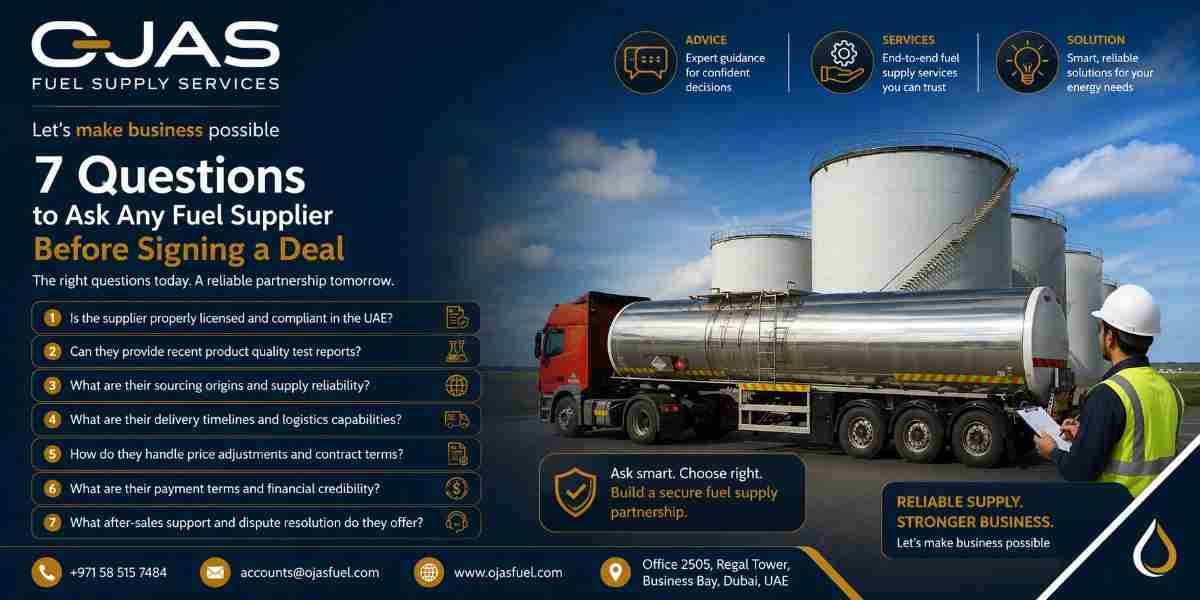
7 Questions to Ask Any Fuel Supplier Before Signing a Deal
Quick Summary
- Confirm the supplier holds a valid UAE petroleum trading permit and licence under Federal Law No. 14 of 2017.
- Request a batch specific Certificate of Analysis for every diesel or MDO shipment.
- Confirm whether the contract uses FOB or CIF terms, and at which named port.
- Accept payment only against verified shipping documents, never upfront cash to unrelated accounts.
- Put dispute resolution and quantity shortfall terms into the written contract, not a verbal promise.
Bulk diesel and Marine Diesel Oil (MDO) agreements carry financial and quality risk when signed unchecked.
The checks below give you a due diligence script to run before signing.
1. Does the Supplier Hold a Valid UAE Petroleum Trading Permit and Licence?
Federal Law No. 14 of 2017 on Petroleum Products Trading requires a Trading Permit from the Competent Authority before a licence can be issued for trading petroleum products anywhere in the UAE, including free zones.
Ask for the permit number, licence copy, and registered trading name, and match all three against the draft contract.
Trading without a permit is illegal trading under the same law, with penalties of up to one year imprisonment and a fine between AED 100,000 and AED 500,000, rising to at least one year imprisonment and a fine between AED 1,000,000 and AED 5,000,000 for repeat offenses. That exposure is reason enough to confirm licensing first.
2. Can the Supplier Provide a Certificate of Analysis for the Diesel or MDO?
A Certificate of Analysis (CoA) for the specific delivered batch should confirm sulphur content, cetane number, density, flash point, and water content against the applicable specification.
Diesel sold as 10 PPM Ultra-Low-Sulphur Diesel (EN 590/Euro V) should carry sulphur content at or below 10 ppm on that CoA, stated for the exact batch.
A generic product data sheet instead of a batch-specific CoA does not prove the cargo meets the agreed specification. Ask for the equivalent document on MDO orders.
3. What Incoterm Applies, FOB or CIF, and at Which Port?
FOB (Free on Board) means the seller delivers goods on board the vessel at the named port of shipment, and risk transfers to the buyer once loaded, under Incoterms 2020 published by the International Chamber of Commerce.
CIF (Cost, Insurance, Freight) keeps the seller responsible for freight and minimum insurance cover to the named destination port, though risk still transfers once goods are on board.
| Term | Risk transfer point | Freight and insurance |
| FOB | Once cargo is loaded at the shipment port | Buyer arranges and pays |
| CIF | Once cargo is loaded at the shipment port | Seller arranges and pays to destination port |
Confirm in writing whether the named port is Jebel Ali or Fujairah, since an Incoterm only works when tied to a specific port.
If the shipment crosses a border, confirm who files export and import customs declarations. Pricing and lead time remain subject to market conditions, product source, destination, and terms agreed at order stage.
4. Can the Supplier Verify the Sourcing Terminal and Prior Deliveries?
Ask the supplier to name the exact loading terminal, tank, or berth at Jebel Ali or Fujairah, and to produce a sample CoA and Bill of Lading from a prior shipment.
A supplier who cannot name a specific terminal has not shown a verifiable link to physical stock.
For MDO delivered at berth or anchorage, ask whether delivery is by barge, pipeline, or road tanker, and how quantity is reconciled against the vessel’s meter readings.
At delivery, the invoice, delivery note, and reconciliation record should match the contracted specification exactly.
5. What Payment Instruments Does the Supplier Accept?
Legitimate suppliers work with standard trade finance instruments: an irrevocable Letter of Credit, a Standby LC, or a telegraphic transfer released against verified shipping documents.
A request for an upfront cash deposit, or payment into an unrelated third party account before documentation has been shown, is a red flag that should stop the deal.
6. What Are the Delivery Timelines and Volume Capacity for Recurring Orders?
Ask for the typical lead time, the minimum and maximum order volumes supported, and how continuity is maintained if regional supply tightens.
Russia’s non-producer diesel and gasoline export ban runs through January 31, 2027, and its separate producer diesel ban, due to expire August 31, 2026.
That supply pressure is reason to lock in written continuity terms now.
7. What Happens If the Delivered Fuel Doesn’t Match the Agreed Specification or Quantity?
Confirm before signing exactly how a shortfall will be resolved, whether by replacement cargo, a credit note, or a written penalty clause, inside the contract rather than a verbal assurance.
Federal Law No. 14 of 2017 sets statutory penalties for trading non-compliant or unlicensed petroleum products, a reason the contract, not a handshake, should carry this protection.
Frequently Asked Questions
- What licence should a UAE diesel supplier show me?
A valid Trading Permit and a licence issued on that permit under Federal Law No. 14 of 2017, specifying the exact location and products covered.
2. What sulphur level should UAE diesel meet?
Diesel sold as 10 PPM Ultra-Low-Sulphur Diesel (EN 590/Euro V) should show sulphur content at or below 10 ppm on the batch Certificate of Analysis.
3. Is FOB or CIF safer for a first time buyer?
Neither is inherently safer. FOB shifts freight and insurance responsibility to the buyer once cargo is loaded; CIF keeps the seller responsible for freight and minimum insurance to the destination port, under Incoterms 2020.
4. What payment method should I avoid?
Avoid any supplier requesting an upfront cash deposit or payment to a personal or unrelated third party account instead of releasing documents against an LC, Standby LC, or verified telegraphic transfer.
5. What ports handle this trade in the UAE?
Jebel Ali Port and Fujairah Port are commonly named loading and delivery gateways for diesel and MDO cargo moving through the UAE.
6. Why does the Russia export ban matter to a UAE buyer right now?
Russia’s non-producer diesel and gasoline export ban runs through January 31, 2027, while a separate ban on producer diesel exports, due to expire August 31, 2026. Both add pressure to global diesel cargo availability.
Ready to Place a Bulk Fuel Order
These checks protect you from licensing gaps, quality disputes, and payment risk on your next order.
If you are sourcing 10 PPM Ultra-Low-Sulphur Diesel (EN 590/Euro V) or Marine Diesel Oil, reach out to discuss Bulk Supply Planning and Diesel Trading coordinated through Jebel Ali or Fujairah.
Mention marine delivery upfront so the request can also be routed for Marine Fuel Coordination.
Share your specification, target port, and volume requirements to get a quote started.