Diesel Supply
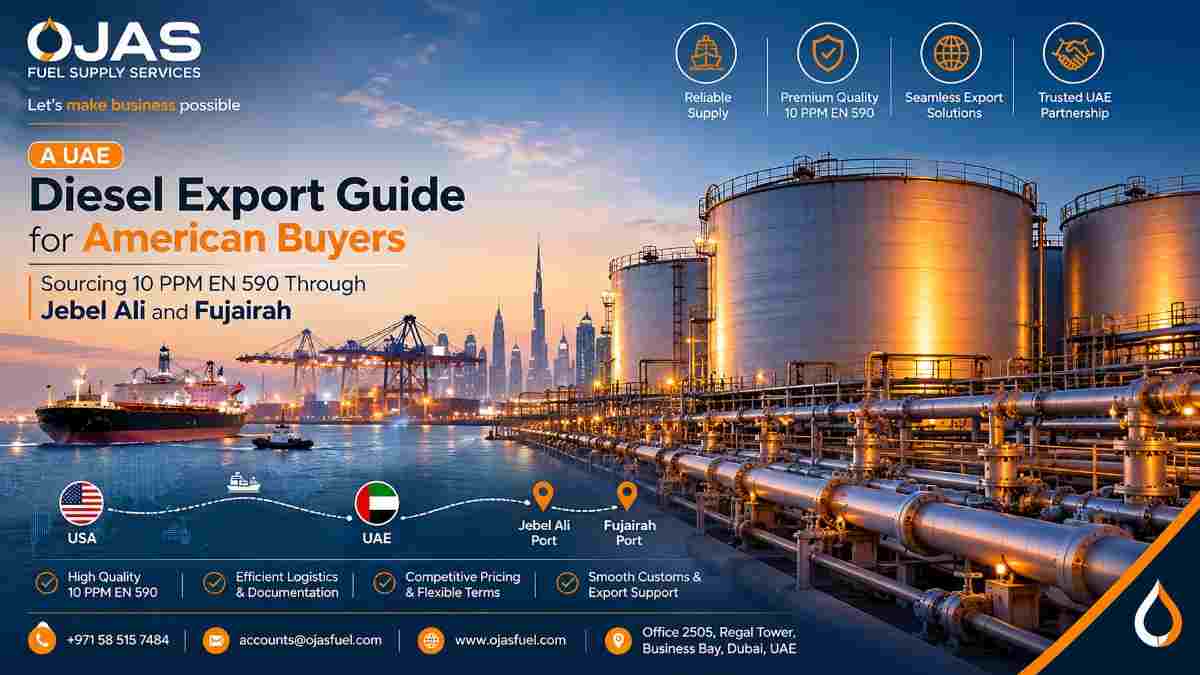
A UAE Diesel Export Guide for American Buyers: Sourcing 10 PPM EN 590 Through Jebel Ali and Fujairah
Quick Summary
- U.S. buyers can source 10 PPM EN 590 diesel from a licensed UAE trading company under Federal Law No. 14 of 2017.
- Standard documentation includes an export invoice, packing list, certificate of origin, and Certificate of Analysis.
- Diesel cargoes move through Jebel Ali or Fujairah Port.
- FOB and CIF both transfer risk at loading; the difference is who pays freight and insurance.
A U.S. buyer can purchase 10 PPM Ultra-Low-Sulphur Diesel (EN 590) from a licensed UAE trading company under a standard export sales contract.
The seller must hold a valid trading authorization under Federal Law No. 14 of 2017, and the shipment must move through Jebel Ali Port or Fujairah Port.
Confirm the trading authorization, request a Certificate of Analysis, and verify the route through Import/Export Facilitation.
What Documents Do I Need to Import Diesel From the UAE?
A standard EN 590 shipment requires an export invoice, packing list, certificate of origin, bill of lading, and Certificate of Analysis on the UAE side.
Dubai Customs’ published customer guide lists the invoice, packing list, and certificate of origin as core proof-of-export documents, while the buyer separately manages its U.S. import entry through a licensed customs broker.
The UAE exporter files the export invoice, packing list, and certificate of origin with Dubai Customs; the bill of lading and Certificate of Analysis come from the loading terminal, and the buyer handles U.S. customs entry separately.
Is UAE Diesel EN 590 Compliant, and How Do I Verify the Specification?
UAE-supplied 10 PPM diesel is produced to the EN 590 automotive diesel standard, capping sulfur at 10 mg/kg under EN 590:2009+A1:2010.
The Emirates Authority for Standardization and Metrology references this limit in its UAE.S 477 diesel specification. Buyers should request a batch-specific Certificate of Analysis before shipment.
| Parameter | Typical EN 590 limit |
| Sulphur content | Max 10 mg/kg |
| Cetane number | Min 51.0 |
| Density at 15°C | 820 to 845 kg/m³ |
| Flash point | Min 55°C |
Product availability, pricing, and delivery lead time remain subject to market conditions and commercial terms agreed upon at the order stage.
Should I Buy Diesel FOB or CIF From a UAE Exporter?
Under Incoterms 2020, FOB and CIF transfer risk to the buyer at the same point, when the diesel loads on board the vessel at Jebel Ali or Fujairah.
The real difference is cost: FOB leaves the buyer to arrange and pay for freight and insurance, while CIF has the seller pay for both to the destination port.
| Term | Risk transfer | Freight paid by | Insurance paid by | Best for |
| FOB | On loading at Jebel Ali or Fujairah | Buyer | Buyer | Buyers with existing arrangements |
| CIF | Same loading point as FOB | Seller, to destination | Seller, minimum cover | First-time buyers wanting bundled logistics |
Both trade terms are structured through Diesel Trading at the quote stage, and pricing and lead time remain subject to market conditions and commercial terms agreed upon at order time.
Why Is UAE Diesel Becoming a More Common Alternative Source in 2026?
Global diesel supply tightened through much of 2026 on multiple fronts.
Russia’s non-producer diesel and gasoline export ban runs through January 31, 2027, while the producer-side ban was set to extend through September 2026.
Separately, around a fifth of Middle East refining capacity remained offline in late August 2026 due to war-related disruption, drawing renewed buyer interest toward stable UAE loading points such as Fujairah.
Do I Need a License to Trade Petroleum Products Out of the UAE?
Yes. Federal Law No. 14 of 2017 requires any party trading, distributing, transporting, or selling petroleum products in the UAE to hold a permit from the competent authority.
A first violation carries a fine of AED 100,000 to 500,000 and up to a year’s imprisonment; repeat violations carry at least a year’s imprisonment plus a fine.
The permit chain runs in sequence: apply for a trading authorization, pass the competent authority’s review, then register in the official trading list.
Which UAE Ports Handle Diesel Export Cargoes?
Diesel export cargoes typically move through two approved UAE gateways: Jebel Ali Port and Fujairah Port.
Each plays a distinct role, from bulk re-export logistics to dedicated refined-products storage and bunkering, so buyers should confirm which gateway their shipment uses before finalizing terms.
- Jebel Ali Port, operated by DP World, handled around 15.5 million TEUs in 2025 as Dubai’s primary deep-water re-export hub.
- Fujairah Port ranks among the world’s top three bunkering hubs, with an official tank storage roster listing 10 terminal operators handling refined products.
Both gateways are served through Marine Fuel Coordination and Import/Export Facilitation.
Frequently Asked Questions
- Can American companies legally import diesel from the UAE?
Yes. A U.S. company can import 10 PPM EN 590 diesel from a UAE trading company holding a valid permit under Federal Law No. 14 of 2017, provided the shipment clears Dubai Customs’ export procedures and the buyer handles its own U.S. import entry through a licensed customs broker.
2. What is 10 PPM EN 590 diesel, and how does it differ from regular diesel?
It is an ultra-low-sulfur automotive diesel capped at 10 mg/kg sulfur under EN 590:2009+A1:2010, well below older diesel grades that permitted up to 350 mg/kg.
The lower sulfur content reduces particulate and sulfur oxide output during combustion and suits modern emission-control systems.
3. What is the difference between EN 590 diesel and Marine Diesel Oil (MDO)?
EN 590 diesel is formulated for automotive and industrial engines, while MDO is a heavier blended fuel used mainly for vessel propulsion and onboard power generation aboard ships.
Ojas coordinates MDO supply separately through Marine Fuel Coordination, distinct from EN 590 trade requests.
4. Which Incoterm is safer for a first-time American buyer, FOB or CIF?
Both FOB and CIF transfer risk at the same point, on loading at the UAE port, so neither is inherently safer from a risk standpoint.
CIF often suits first-time buyers better because the seller arranges and pays for freight and minimum insurance to the destination port.
5. How has the 2026 Middle East energy disruption affected diesel export availability from the UAE?
Reuters reported on August 26, 2026, that around a fifth of Middle East refining capacity remained offline due to war-related disruption.
This tightened regional diesel supply and increased buyer interest in UAE loading points such as Fujairah and Jebel Ali.
Request a Diesel Export Quote
If you are a U.S. buyer evaluating a UAE source for 10 PPM Ultra-Low-Sulphur Diesel (EN 590), Ojas Fuel Supply Services LLC coordinates the sourcing process from documentation through port selection.
This includes verifying the UAE seller’s trading authorization under Federal Law No. 14 of 2017, requesting a Certificate of Analysis, and confirming whether FOB or CIF terms fit your logistics setup before cargo moves through Jebel Ali Port or Fujairah Port.
Coordination runs under Import/Export Facilitation, supported by Bulk Supply Planning for buyers with recurring or scheduled volume needs.