Diesel Supply
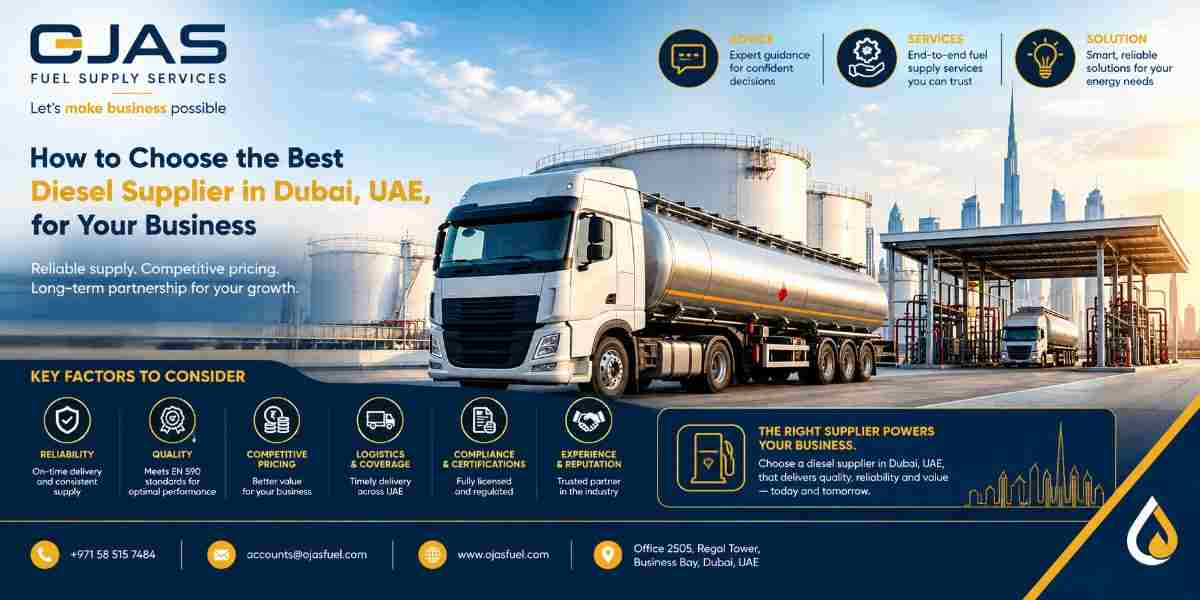
How to Choose the Best Diesel Supplier in Dubai, UAE, for Your Business
Quick Summary
- Confirm a valid trade license and active Trading Permit under Federal Law No. 14 of 2017.
- Confirm 10 PPM Ultra-Low-Sulphur Diesel (EN 590) specs with a batch Certificate of Analysis.
- Get written terms on minimum order quantity, delivery charges, and emergency coverage.
- Compare FOB and CIF terms under ICC Incoterms 2020 based on your logistics setup.
- Illegal trading under Federal Law No. 14 of 2017 carries fines from AED 100,000 to AED 500,000.
Diesel supply interruptions can halt construction sites, fleets, and industrial lines within hours. A supplier chosen on price alone, without checked licensing, creates operational and regulatory exposure.
Federal Law No. 14 of 2017 makes it illegal to trade petroleum products anywhere in the UAE, including free zones, without a Trading Permit, so an unapproved sourcing channel can expose your own business too.
Continue reading the article to learn more.
How Do You Know If a Diesel Supplier in Dubai Is Reliable Before Signing?
A legitimate Dubai diesel supplier holds a valid trade license and an active Trading Permit under Federal Law No. 14 of 2017, sourcing products only through licensed channels.
Ask for the license number, the Trading Permit reference, and a delivery record from a period of peak demand. A supplier unwilling to share this in writing is a warning sign.
What Fuel Quality Standard Should the Diesel Meet?
UAE diesel for modern engines should meet the 10 PPM Ultra-Low-Sulphur Diesel (EN 590) specification.
A credible supplier confirms sulfur content, cetane number, and density against this standard and can produce batch-level data before you sign, not only after delivery.
- Sulphur content: maximum 10 mg/kg, per EN 590.
- Cetane number: minimum 51.0.
- Density: 820.0-845.0 kg/m³ at 15°C, flash point above 55°C.
What Documentation Should Come With Every Delivery?
Every bulk diesel delivery should include a delivery note, a quantity confirmation, and a Certificate of Analysis (COA) for that batch.
A COA is a batch-specific record confirming sulfur, cetane, and density against EN 590. Audit-sensitive operations should treat missing documentation as a disqualifying red flag.
What Should You Ask About Minimum Order Quantity and Emergency Delivery?
Reliable suppliers state a written emergency response window, a minimum order quantity, and a defined coverage area rather than vague reassurances.
Confirm whether coverage extends across all seven Emirates or only select zones, and ask what surge pricing applies for urgent orders.
Product availability, pricing, and delivery lead time remain subject to market conditions, product source, destination, and commercial terms agreed at the order stage.
FOB vs. CIF Diesel Supply: Which Contract Structure Fits Your Business?
Under FOB terms, the buyer takes on shipping arrangements once diesel is loaded on board at the port of shipment, suitably buying buyers with established logistics.
Under CIF terms, the supplier arranges and pays freight and insurance to the destination port instead. The right choice depends on your logistics capability, not price alone.
| Term | Seller Obligation | Risk Transfer Point | Best Suited For |
|---|---|---|---|
| FOB | Delivers goods on board at port of shipment | Once loaded on board | Buyers with freight arrangements |
| CIF | Arranges freight and insurance to destination | Once loaded on board | Buyers without shipping capability |
These definitions follow ICC Incoterms 2020. Under both terms the risk transfer point is identical; the difference is who arranges and pays for freight and insurance onward.
How Is Diesel Priced, and What Should a Transparent Quote Include?
Diesel in the UAE is typically priced on a market-linked basis tied to refined product benchmarks, not a fixed retail rate.
A transparent quote itemizes the per-liter rate, delivery charge, minimum order quantity, and any surcharge basis clearly in writing before you confirm the order.
Product availability, pricing, and delivery lead time remain subject to market conditions, product source, destination, and commercial terms agreed at the order stage.
What Are the Regulatory Consequences of Choosing an Unlicensed Supplier?
Federal Law No. 14 of 2017 classifies trading without a Trading Permit, selling non-compliant products, or acquiring petroleum products of unknown source as illegal trading.
Article 14 of the law sets a fine of AED 100,000 to AED 500,000, imprisonment of up to one year, or both, for these offenses.
Repeat offenses carry a minimum one-year prison term and a fine of AED 1,000,000 to AED 5,000,000, and courts confiscate the seized product in every case. A separate provision fines a licensee up to AED 500,000 for knowingly acquiring product from an unlicensed trader.
Bringing It Together
Choosing a diesel supplier in Dubai works best as a documented compliance check, not a price comparison alone. Confirm the Trading Permit, verify the EN 590 spec, request the COA, and clarify FOB or CIF responsibility.
Understanding how Diesel Trading, Supply Coordination, and Bulk Supply Planning arrangements work clarifies what a compliant relationship looks like, and cross-border buyers should also understand how Import/Export Facilitation applies to FOB and CIF structures.
Frequently Asked Questions
1. Is it legal to buy diesel in bulk from an unlicensed supplier in Dubai?
No. Federal Law No. 14 of 2017 classifies acquiring petroleum products from an unlicensed trader as illegal trading, and a licensee who knowingly does so faces a fine of up to AED 500,000. Buyers risk product confiscation and disrupted supply from working with unlicensed suppliers.
2. What sulphur level should business diesel meet in the UAE?
Modern diesel engines require 10 PPM Ultra-Low-Sulphur Diesel aligned with the EN 590 specification.
Before accepting a bulk delivery, request written confirmation of sulfur content, cetane number, and density, plus a batch-specific Certificate of Analysis from the supplier before the order is confirmed.
3. What is a Certificate of Analysis (COA) and why does it matter?
A COA is a batch-specific document confirming a diesel delivery’s sulphur content, density, and cetane number meet the approved specification.
It proves that a specific delivered batch, not just the supplier’s general reputation, meets the required EN 590 standard for that order.
4. What is the difference between FOB and CIF diesel pricing?
Under FOB, the buyer arranges and pays for ocean freight and insurance once diesel is loaded at the port, giving more logistics control.
Under CIF, the supplier arranges freight and insurance to the destination port, suitably buying buyers without in-house shipping infrastructure.
5. What happens if a supplier delivers diesel that fails quality specifications?
Federal Law No. 14 of 2017 treats selling or supplying non-compliant petroleum products as illegal trading, carrying a fine of AED 100,000 to AED 500,000, possible imprisonment, and confiscation of the product.
Buyers should contractually require COA verification and a written remedy clause for non-conforming batches.
Ready to Review Your Diesel Supply Terms?
If you are evaluating diesel suppliers for a construction fleet, industrial site, or logistics operation in Dubai, a documented, Permit-verified supply arrangement protects your business from operational and regulatory risk.
Ojas Fuel Supply Services LLC coordinates diesel trading arrangements for 10 PPM Ultra-Low-Sulphur Diesel (EN 590), connecting procurement buyers across the GCC and wider MENA region with supply channels routed through Jebel Ali Port.
Our team can guide you through documentation, EN 590 checks, and FOB or CIF contract options.
Contact Ojas Fuel Supply Services to request a diesel supply quote.