Diesel Supply
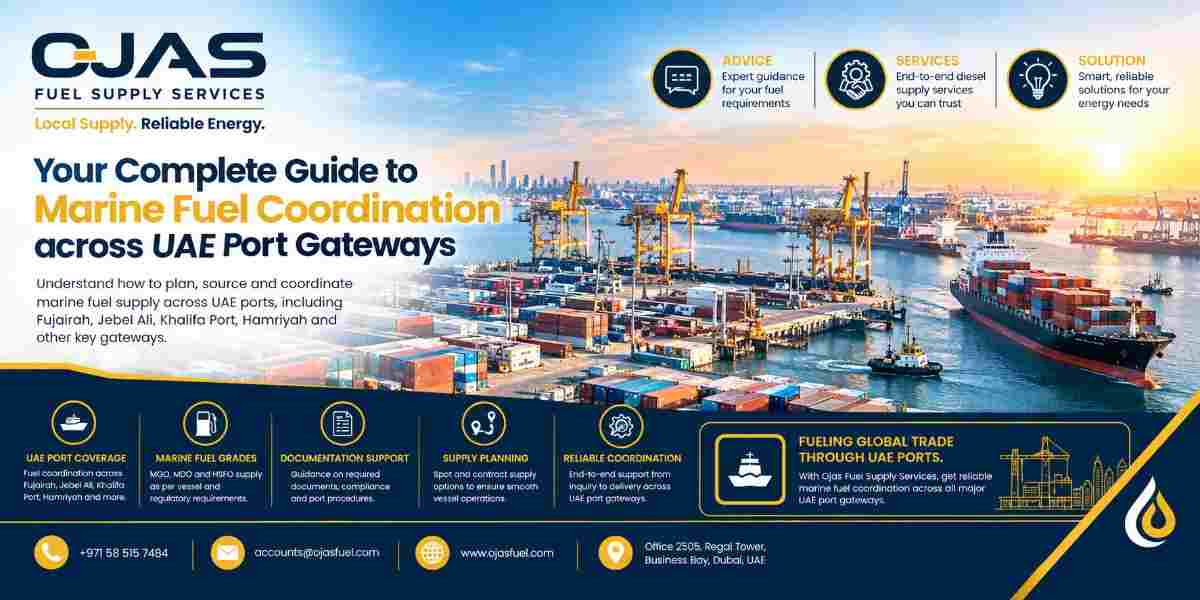
Your complete guide to Marine Fuel Coordination across UAE port gateways
Summary:
- Streamline your procurement through authorized supply coordination at Jebel Ali Port and Fujairah Port.
- Strict adherence to ESMA standards ensures you receive compliant Marine Diesel Oil (MDO).
- Proper cross-border documentation aligns your operations with ICC Incoterms 2020 protocols.
- Verifiable Bunker Delivery Notes protect your fleet during port state control inspections.
Securing reliable marine bunkering demands precise logistical planning and strict adherence to commercial regulatory frameworks. As you manage international fleet operations, coordinating timely fuel deliveries becomes critical to maintaining profitable voyage schedules.
This guide covers how effective Marine Fuel Coordination connects your commercial fuel demand with disciplined logistics execution.
You will discover actionable strategies for navigating complex port environments while securing compliant Marine Diesel Oil (MDO) for your vessels.
Who is in charge of buying the bunker?
Vessel chief engineers determine the precise volume and fuel specifications required for a planned voyage. Your shore-based procurement team then executes the commercial transaction to secure the fuel. You must partner with licensed coordinators to arrange these deliveries without delaying your port turnarounds.
The procurement process demands seamless communication between your technical command and your onshore commercial desk. When your ship requires Marine Diesel Oil (MDO), your engineering team calculates the necessary volume based on the specific route.
You must ensure your selected supply partner operates legally under Federal Law No. 14/2017 to conduct petroleum trading. This regulatory alignment protects your fleet from operational delays.
Procurement teams scheduling deliveries at Jebel Ali Port must navigate complex logistical variables alongside cargo movements. According to official port data, the terminal connects ocean services with over 150 global ports.
Your bunker deliveries must be scheduled meticulously alongside these cargo operations. This bunkering supply coordination ensures you avoid costly demurrage and maintain route reliability.
How do you decide between spot deals and term contracts?
You select suppliers based on verifiable regulatory licensing, guaranteed product specifications, and reliable terminal infrastructure.
Your refueling is secured through spot deals for immediate port calls or term contracts for scheduled routes. Authorized coordinators facilitate product availability regardless of the procurement contract utilized.
The decision matrix for selecting a supplier hinges on mitigating your operational and compliance risks. According to ESMA standards, buyers place immense scrutiny on the ability of a supplier to arrange specification-grade fuel.
You must evaluate physical infrastructure carefully before making commercial commitments. You should prefer partners with reliable access to major gateways like Fujairah Port and Hamriyah Port.
| Procurement Model | Commercial Application | Price Structure | Delivery Coordination |
| Spot Market Deal | Immediate refueling for vessels without fixed schedules. | Current daily market index rates plus delivery premiums. | Requires rapid coordination with terminal operators. |
| Term Contract | Scheduled refueling for liner services and dedicated export routes. | Fixed pricing mechanisms or agreed index-linked formulas. | Pre-allocated volumes guaranteeing priority barge scheduling. |
Both procurement models remain subject to strict UAE commercial regulations regarding petroleum transfers. Your counterparty must be fully registered, as trading with unauthorized entities can result in fines up to 500,000 Dirhams under Federal Law No. 14/2017.
Engaging with compliant coordinators removes unnecessary complexity from your fuel procurement process. You achieve total confidence in your bunkering supply coordination.
What must a Bunker Delivery Note included?
The Bunker Delivery Note serves as the mandatory statutory document transferred during your marine refueling operations.
It must detail the registered name of your vessel, delivery port, supplier contact information, product name, and exact quantity. This documentation satisfies strict environmental compliance and port state control inspections.
The Bunker Delivery Note remains the definitive legal record of your physical fuel transfer. You must ensure the document is accompanied by a physical fuel sample of no less than 400 ml.
According to the Federal Customs Authority, accurate cross-border documentation is vital for clearing international maritime traffic. Maintaining this accurate paperwork protects your company from costly compliance disputes.
Your documentation must clearly reflect the agreed commercial terms for your marine bunkering order. The minimum order quantity is 13,000 Imperial Gallons (IG), which is approximately 59,100 liters or roughly 49 metric tons of diesel depending on density from Ojas.
You must ensure all commercial documentation accurately reflects this exact volume to satisfy port authorities.
Product availability, pricing, and delivery lead time remain subject to market conditions, product source, destination, and commercial terms agreed at the order stage.
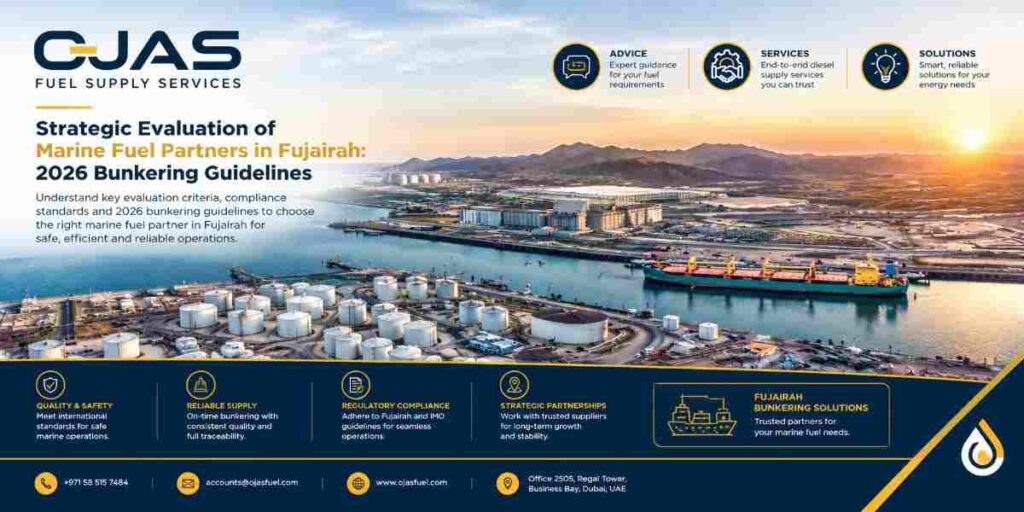
Why are vessels anchoring near Fujairah Port?
Fujairah Port operates as a premier global marine bunkering hub located strategically outside the Strait of Hormuz.
This geographic advantage allows your vessels to refuel efficiently without traversing sensitive geopolitical chokepoints. You achieve unparalleled supply chain security and mitigate insurance risks associated with regional transit.
The density of vessel traffic anchored near Fujairah is a direct result of its status as a premier refueling hub.
According to the U.S. EIA, significant volumes of petroleum products bypass the Strait of Hormuz by utilizing the infrastructure at Fujairah. Your vessels prioritizing risk mitigation actively choose to bunker here rather than entering the Gulf. This strategic choice directly enhances your fleet continuity.
The massive onshore storage infrastructure and deep-water anchorages create an ideal environment for your high-volume marine fuel requirements. According to the IEA, displacing oil with gas in power sectors allows more refined products to be exported or used as bunker fuel.
Ships loading export cargo bound for Europe or East Africa rely heavily on these rapid turnaround times. You depend on this continuous product availability to maintain tight logistical schedules.
Managing cross-border documentation with ICC Incoterms 2020
The ICC Incoterms 2020 framework dictates the exact moment risk and cost transfer from the seller to your company during international transactions.
These terms clarify your responsibilities regarding cross-border documentation, vessel loading, and freight insurance. You must apply them correctly to successfully manage your import/export facilitation.
Procurement buyers engaging in Bulk Supply Planning for international routes frequently rely on specific contractual terms.
According to ICC Incoterms 2020, Cost Insurance and Freight (CIF) terms dictate that the seller covers freight, but physical risk transfers to the buyer once goods are loaded on board.
This distinction is critical for establishing liability in the event of contamination. It protects your commercial interests during transit across the Asia-Pacific region.
Alternatively, Free On Board (FOB) terms alter the division of responsibility between you and the seller. Under ICC Incoterms 2020, FOB terms dictate that risk transfers once the fuel is delivered safely on board the vessel provided by the buyer.
Buyers utilizing these terms for shipments bound for Central Asia must ensure their commercial contracts align perfectly. Proper application of these rules prevents costly disputes over terminal handling charges.
Frequently Asked Questions
1. What is the minimum order quantity for marine bunkering from Ojas?
The minimum order quantity for Marine Diesel Oil (MDO) is 13,000 Imperial Gallons (IG) per order. This equals roughly 59,100 liters or 49 metric tons of diesel, applying universally to deliveries.
2. What payment terms are accepted for marine fuel supply?
Accepted payment terms are limited exclusively for Ojas including Upfront, Cash on Delivery, or Bank Transfer on Delivery Before Offloading only.
You must commercially settle these terms prior to the finalization of the Bunker Delivery Note. This protocol ensures secure supply coordination across all supported UAE port gateways.
3. Can marine diesel be supplied for export routes?
You can request Import/Export Facilitation for vessels operating on direct export routes to Europe, East Africa, West Africa, and the Asia-Pacific.
The fuel arranged complies fully with international maritime specifications. This ensures you achieve smooth port state control clearances upon arrival at your destination.
4. What specifications apply to Marine Diesel Oil?
Marine Diesel Oil (MDO) supplied must meet the strict parameters of the required international frameworks. According to ESMA, standard specifications approved by the authority must be met to ensure the fuel maintains proper viscosity. This diligence prevents catastrophic engine failure during your voyage.
5. Are there penalties for non-compliant fuel trading?
Purchasing from or trading with unlicensed entities carries severe financial penalties within the region.
Under Federal Law No. 14/2017, violations can result in imprisonment and fines ranging from 100,000 to 500,000 Dirhams. Authorities may also legally confiscate the non-compliant petroleum products from your vessel.
6. Reliable Marine Fuel Coordination
For reliable Marine Fuel Coordination and compliant physical delivery, securing the right supply partner is essential. Vessel operators and procurement buyers require total confidence in their fuel sourcing to maintain operational continuity across regional trade corridors.
Ojas Fuel Supply Services LLC coordinates, facilitates, and arranges premium petroleum products, connecting your commercial fuel demand with disciplined logistics execution.
Final Words
Whether your fleet requires Marine Diesel Oil (MDO) at Jebel Ali Port or 10 PPM Ultra-Low-Sulphur Diesel (EN 590) for an onward voyage, structured coordination ensures seamless operations.