Ojas Fuel
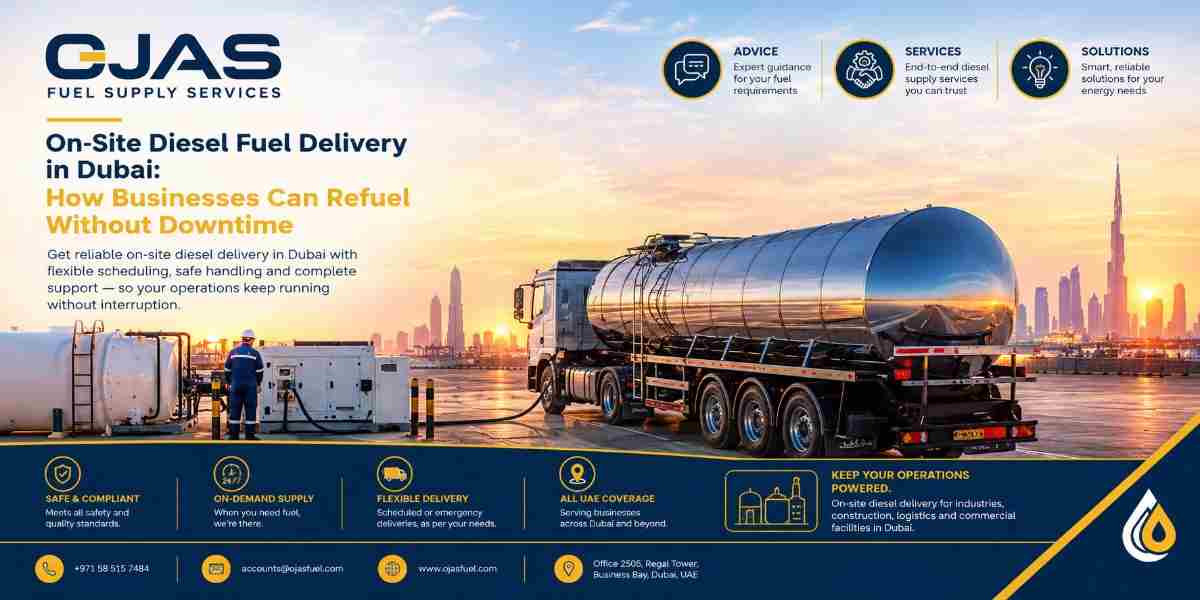
On-Site Diesel Fuel Delivery in Dubai: How Businesses Can Refuel Without Downtime
Key Highlights
- Consistent fuel access requires structured Bulk Supply Planning through authorized distribution channels.
- Strict compliance with UAE petroleum trading regulations prevents operational shutdowns and severe legal penalties.
- Standardized commercial terms and universal volume thresholds streamline the industrial procurement process.
- Applying proper Incoterms ensures transparent risk management during cross-border Import/Export Facilitation.
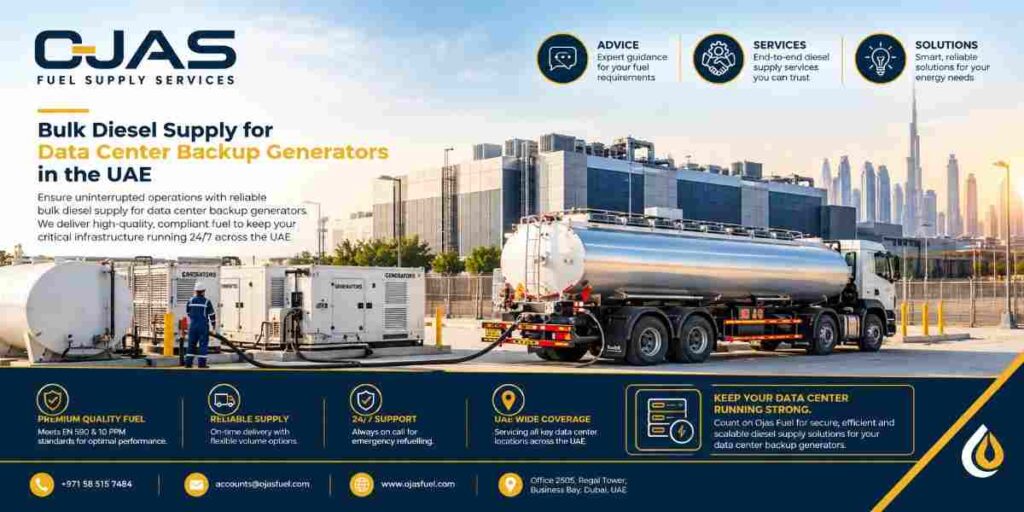
In Dubai’s industrial sector, maintaining seamless operations is critical. Reliable on-site diesel fuel delivery provides businesses with a direct refueling solution.
This eliminates fleet transit time to commercial fuel stations. As a result, companies can ensure continuous power generation, steady construction progress, and high logistical efficiency without costly downtime.
Keep reading the article to learn more.
What is the minimum order quantity for 10 ppm diesel in the UAE for Ojas?
The established minimum order quantity for commercial delivery is strictly 13,000 Imperial Gallons per order.
This precise volume requirement applies universally across all domestic distribution routes and encompasses all confirmed products, ensuring scaled logistical efficiency for industrial buyers across the market.
This universal volume threshold remains non-negotiable for orders of 10 PPM Ultra-Low-Sulphur Diesel (EN 590) or Marine Diesel Oil (MDO).
How is Bunker Delivery Note documentation handled for marine bunkering?
Marine bunkering for maritime operations at Jebel Ali Port and Fujairah Port requires a standardized Bunker Delivery Note.
This document verifies the exact volume and specifications of the transferred Marine Diesel Oil (MDO). It serves as the primary statutory record for international maritime compliance.
Accurate record-keeping is essential during every fuel transfer. DP World confirms that Jebel Ali Port offers dedicated liquid bulk handling capabilities to support specialized maritime logistics securely.
Professional coordinators oversee these transfers with thorough documentation. Consequently, the Bunker Delivery Note functions as the definitive legal receipt for vessel fuel supply.
Proper execution of this note protects commercial vessels from potential port authority disputes. Furthermore, the Emirates Authority for Standardization and Metrology regulates technical specifications for domestic fuel quality.
Delivery documentation confirms that the transferred Marine Diesel Oil meets all necessary operational criteria. Ship operators must verify and sign the note immediately after the physical transfer is completed.
What are the accepted payment terms for on-site petroleum distribution for Ojas?
Commercial buyers can finalize procurement using three rigidly controlled financial settlement methods. Buyers must settle transactions via Upfront payment, Cash on Delivery, or Bank Transfer Before Offloading.
These structured terms ensure transparent transaction execution and immediate authorization for the physical transfer of fuel at the delivery site.
Maintaining financial discipline ensures that energy supply proceeds without logistical interruption. Corporate commercial policy strictly limits standard payment terms to these three options, with no exceptions permitted by port or product.
Standardizing payment protocols protects supply chain integrity across the regional supply corridor.
How do 2026 Strait of Hormuz disruptions affect ULSD pricing?
International supply chain disruptions heavily influence physical barrel availability and wholesale costs.
With commercial vessel transit restricted in 2026, securing a formalized relationship with a compliant domestic distributor ensures prioritized fuel allocation, shielding industrial operations from sudden spot-market shortages and severe price volatility.
Geopolitical tensions have significantly constrained the transit of commercial commodity vessels in the region. According to Reuters, daily passages through the Strait of Hormuz dropped from a historical average of 125 down to single digits by late Q3 2026.
So, procurement teams must structure agreements proactively to navigate these severe logistical bottlenecks, relying on secure overland and port gateways.
These transit restrictions directly impact the wholesale cost of middle distillates. The U.S. EIA October 2026 Short-Term Energy Outlook forecasts Brent crude spot prices to average 105 dollars per barrel in the fourth quarter due to extreme tightness in diesel markets.
After all, partnering with a skilled coordinator insulates construction and infrastructure projects from these global pricing shocks, providing stability when spot markets become unpredictable.
Which UAE port gateways support regional cross-border logistics?
Strategic port access dictates the efficiency of the regional supply corridor.
Commercial operations currently utilize Jebel Ali Port, Fujairah Port, Hamriyah Port, and Khalifa Port to facilitate seamless cargo movements. Selecting the appropriate gateway ensures the product reaches its destination without unnecessary customs delays.
Each authorized port offers distinct operational advantages for specific industry requirements.
Official data from DP World indicates that Jebel Ali Port features 27 berths and over 1.4 million square meters of yard space to accommodate massive logistical scale.
Cargo transit is routed through the gateway that best matches the required delivery timeline and maritime specifications.
| Authorized Port Gateway | Primary Logistics Advantage | Confirmed UAE Location |
| Jebel Ali Port | Extensive re-export and liquid bulk logistics scale | Dubai |
| Fujairah Port | Strategic energy bunkering outside the Strait of Hormuz | Fujairah |
| Hamriyah Port | Dedicated liquid bulk berths for industrial manufacturing | Sharjah |
| Khalifa Port | Deep-water liquid and gas cargo terminal integration | Abu Dhabi |
How does Import/Export Facilitation rely on ICC Incoterms 2020?
Cross-border fuel logistics require a precise allocation of risk and cost between buyer and seller.
Applying ICC Incoterms 2020 rules ensures that Import/Export Facilitation runs smoothly, defining exactly when liability transfers during the transit of commercial commodities across international borders.
Proper alignment of these trade terms eliminates ambiguity during cross-border documentation processes. Under ICC Incoterms 2020, the CIF rule mandates that the seller secures minimum insurance coverage under Institute Cargo Clauses C.
Supply coordinators arrange these structural frameworks to support export buyers across East, Central, and West Africa. Corporations must carefully evaluate organizational risk tolerance before finalizing international trade agreements.
Upgrading trade terms can provide enhanced protection for high-value petroleum transfers. The CIP rule within the ICC Incoterms 2020 framework requires the seller to provide all-risk coverage under Institute Cargo Clauses A.
Properly arranged shipping documents reflect these exact commercial agreements accurately, ensuring commodities reach their destination securely and compliantly.
Frequently Asked Questions
1. Can businesses request partial deliveries below the bulk threshold from Ojas?
No, partial deliveries are not permitted under standard operational protocols. The established minimum order quantity is strictly 13,000 Imperial Gallons per order.
This volume requirement applies universally across all confirmed commodities, including 10 PPM EN 590 ultra-low-sulfur diesel and Marine Diesel Oil.
2. Are there alternative payment terms available for first-time buyers from Ojas?
Standard payment conditions are rigidly controlled to ensure supply chain integrity.
All commercial transactions must be settled via Upfront payment, Cash on Delivery, or Bank Transfer Before Offloading. No alternative credit facilities or extended terms are accepted without prior, explicit management authorization.
3. Does the diesel delivery service cover all regions within the UAE?
Yes, compliant diesel distribution operations cover all seven Emirates.
Authorized supply chains ensure continuous, on-site fuel delivery for commercial and industrial facilities operating anywhere within the UAE domestic borders.
Properly permitted transportation fleets are utilized to maintain strict operational continuity for commercial sites.
4. Can Marine Diesel Oil (MDO) be exported or delivered to local ports?
Yes, Marine Diesel Oil (MDO) bunkering and export facilitation are fully supported at designated international trade gateways.
Supply operations are arranged specifically through Jebel Ali, Fujairah, Hamriyah, and Khalifa ports to meet regional maritime requirements and service export corridors to Europe and Africa.
5. How is 10 ppm EN 590 diesel verified upon delivery?
Every on-site delivery requires strict documentation control, specifically a Certificate of Analysis.
Buyers receive product verified against ESMA specifications, ensuring the automotive gas oil maintains a maximum sulfur content of 10 ppm. This precise chemical composition is critical for environmental compliance and modern engine longevity.
Secure Bulk Supply Planning Today
Reliable on-site diesel fuel delivery in Dubai remains essential to maintain operational continuity.
Securing compliant, specification-grade fuel access must be tailored to specific plant fuel requirements. Preventing costly downtime requires leveraging a robust network across key UAE port gateways.
Product availability, pricing, and delivery lead time remain subject to market conditions, product source, destination, and commercial terms agreed at the order stage.