Diesel Supply
Diesel Price Trends in UAE: Strategic Procurement for Commercial Fleets
Key Highlights
- Prolonged refinery capacity shortages keep middle distillate crack spreads elevated, directly impacting procurement budgets.
- Federal Law No. 14/2017 enforces severe financial penalties for unauthorized petroleum trading, requiring verifiable sourcing channels.
- Maritime operations require a mandatory Bunker Delivery Note at UAE gateways like Fujairah Port.
- Strategic Import/Export Facilitation leverages ICC Incoterms 2020 and Ministerial Decision 265/2023 to protect cross-border margins.
Commercial automotive gas oil prices remain subject to intense global market pressure driven by constrained refinery outputs and geopolitical supply shocks.
Procurement buyers securing bulk deliveries navigate this volatility utilizing standardized internal minimum order quantities of 13,000 Imperial Gallons of Ojas. Payment protocols require strict financial discipline, limited to Upfront, Cash on Delivery, or Bank Transfer Before Offloading.
Procurement operations must factor in elevated crude costs, as Brent crude reached $103.98 per barrel in September 2026 during recent supply compressions.
The International Energy Agency notes that previously available inventory buffers are rapidly depleting, intensifying the supply-demand gap for refined products across regional trade corridors.
Because fleet fuel costs typically consume a vast portion of total road-transport operating expenses, accurately modeling the financial impact of monthly price adjustments is critical for logistics providers.
Key considerations for navigating this volatility include:
- Predictable Volumes: Structuring Bulk Supply Planning around reliable baselines mitigates the operational risk of spot-market fluctuations.
- Clear Terms: Utilizing transparent payment terms ensures smooth financial execution during turbulent market phases.
- Market Monitoring: Staying attuned to global supply compressions allows procurement teams to adjust timelines proactively.
How does global refining capacity impact the 10 ppm crack spread?
Global 10 PPM Ultra-Low-Sulphur Diesel (EN 590) prices remain elevated primarily due to severe refining capacity shortages. Prolonged supply chain disruptions have constrained refined petroleum pools, pushing the middle distillate crack spread to exceptionally high levels for commercial fuel buyers worldwide.
The scarcity of physical conversion capability serves as the primary price catalyst across international markets.
The U.S. Energy Information Administration confirmed that the diesel crack spread widened significantly as U.S. distillate stocks sat 13 percent below five-year averages in September 2026.
This scarcity keeps the premium on prompt physical supply unusually high, while global oil supply saw significant contractions earlier in 2026.
For industrial facilities requiring continuous production, these bottlenecks highlight the necessity of professional Supply Coordination to maintain operational runtimes without disruption.
UAE regulatory frameworks for petroleum trading
Entities procuring uncertified petroleum products face aggressive prosecution under Federal Law No. 14 of 2017. The legislative framework mandates that all commercial fuel movements occur exclusively through licensed channels, ensuring product integrity and environmental safety.
Businesses attempting to bypass market rates by sourcing from unverified operators absorb extreme operational risks. Federal Law No. 14 of 2017 explicitly classifies the possession of petroleum products from unknown sources in commercial quantities as illegal trading.
Initial violations for trading without authorization or selling non-compliant products incur fines up to 500,000 dirhams. Repeat offenses carry severe penalties, including a minimum of one year of imprisonment and fines ranging from one million to five million dirhams.
To ensure commercial compliance, procurement teams must verify:
- Licensed Channels: Only procure through entities officially authorized to operate within the UAE.
- Specification Standards: Ensure the product aligns with approved national standard specifications.
- Source Verification: Avoid products of unknown origin to eliminate the risk of severe regulatory fines.
What documentation guarantees compliance for marine bunkers at Fujairah Port?
Vessel operators receiving marine bunkers at Fujairah Port must secure a formal Bunker Delivery Note to guarantee international regulatory compliance.
This mandatory statutory document confirms that the physical delivery of Marine Diesel Oil satisfies established environmental and technical parameters before the receiving vessel re-enters maritime jurisdictions.
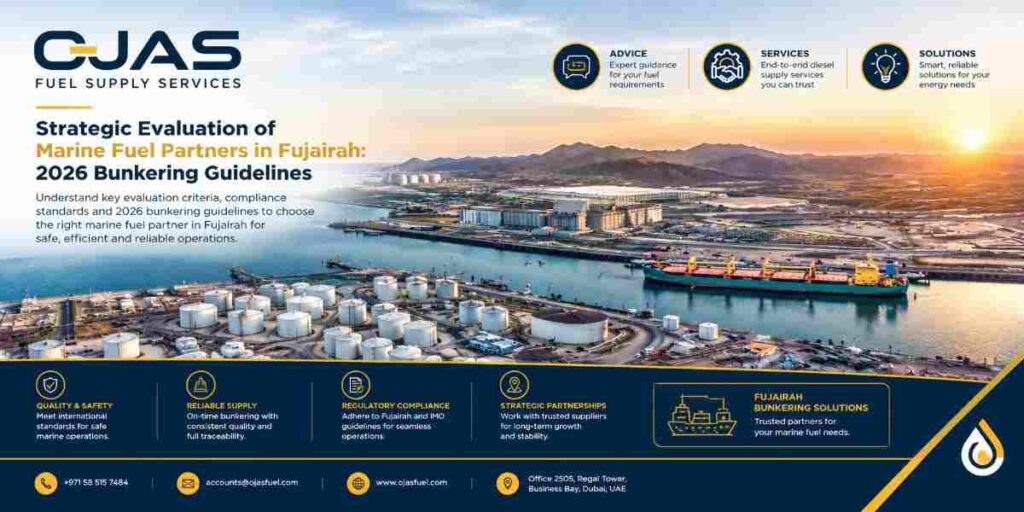
Positioned strategically outside the Strait of Hormuz, Fujairah Port relies on strict environmental and technical oversight to manage high-volume marine traffic safely. Marine Fuel Coordination focuses exclusively on compliant Marine Diesel Oil (MDO) that aligns with international frameworks.
Maintaining uninterrupted shipping channels is critical for the region, as supply chain resilience directly impacts broader fuel availability during supply constraints.
Because non-compliant emissions can result in costly detentions, ensuring the supplied Marine Diesel Oil is verified provides operational assurance for shipping lines navigating complex international emission control areas.
Customs facilitation and Incoterms 2020 for Jebel Ali export cargo
Exporting 10 PPM Ultra-Low-Sulphur Diesel (EN 590) from Jebel Ali Port to international destinations requires strict adherence to customs frameworks and taxation baselines.
Transnational shipments must navigate Ministerial Decision 265/2023 regulations while clearly defining international risk transfer protocols utilizing ICC Incoterms 2020 frameworks.
As a primary gateway for international trade, Jebel Ali Port facilitates seamless outbound logistics, provided the export cargo meets technical specifications supported by a verified Certificate of Analysis.
The distribution of goods from designated zones to international buyers represents a qualifying activity under Ministerial Decision 265/2023, making precise administrative execution vital for trading and export buyers.
Cross-border transactions benefit from structured Import/Export Facilitation by focusing on:
- Risk Transfer: Defining responsibilities using Cost, Insurance, and Freight arrangements ensures the seller bears the transit risk up to the destination port.
- Volume Conversion: When addressing European buyers specifically, a standard bulk order of 13,000 Imperial Gallons translates to approximately 59,100 liters, roughly 49 metric tons of diesel, density-dependent.
- Documentation: Precise customs paperwork prevents costly delays at the port-of-discharge.
| Operational Focus | Governing Standard / Authority | Primary Implication for Commercial Procurement |
| Domestic Fuel Trading | Federal Law No. 14/2017 | Repeat unauthorized sourcing incurs fines up to five million dirhams. |
| Maritime Bunkering | Fujairah Port / MARPOL | A mandatory bunker delivery note is required for all MDO transfers. |
| Export Taxation | Ministerial Decision 265/2023 | Designated zone distribution is treated as a qualifying activity. |
| Cross-Border Risk | ICC Incoterms 2020 | Clearly outlines buyer and seller responsibilities during transit. |
Product availability, pricing, and delivery lead time remain subject to market conditions, product source, destination, and commercial terms agreed at the order stage.
Frequently Asked Questions
1. What is the commercial minimum order quantity and accepted payment structure for Ojas?
The standing minimum order quantity for all commercial supplies is precisely 13,000 Imperial Gallons per transaction. Approved financial settlement terms are exclusively restricted to Upfront payments, Cash on Delivery, or Bank Transfer Before Offloading.
2. Is 10 ppm diesel available for bulk export to African markets?
Commercial 10 PPM Ultra-Low-Sulfur Diesel (EN 590) can be coordinated for maritime export to destination countries in East, Central, and West Africa via Jebel Ali Port and Fujairah Port. Import/Export Facilitation ensures documentation aligns with regional customs authority regulations.
3. Can vessel operators procure Marine Gas Oil for bunkering operations?
Marine Gas Oil is not available through this specific framework. Marine Fuel Coordination focuses exclusively on compliant Marine Diesel Oil (MDO). All deliveries include a verified Bunker Delivery Note to meet the environmental stipulations of international maritime authorities.
4. Does bulk diesel supply coordination cover all regions within the country?
The regional supply corridor actively supports bulk commercial operations across all seven Emirates. Construction and infrastructure buyers, logistics providers, and industrial facilities can secure reliable deliveries provided they satisfy baseline commercial volume requirements.
5. How is the physical quality of automotive gas oil verified upon delivery?
The quality of delivered fuel is maintained through strict specification discipline. Every bulk distribution is aligned with recognized EN 590 parameters, supported by an available Certificate of Analysis, and cross-checked against standard delivery notes.
Secure Reliable Supply Coordination
For current market rates and to maintain operational continuity for heavy equipment fuel operations, industrial facilities, or maritime assets, procurement managers must rely on precise planning.
Site fuel management and genset continuity remain uninterrupted during periods of market volatility when utilizing professional Bulk Supply Planning.
Buyers can outline exact volume requirements to facilitate the structured product access required across GCC, MENA, and international trade corridors.