Ojas Fuel
Understanding Landed Cost Basics for Fuel Imports Into the UAE
Quick Summary
- Landed cost combines product price, freight, insurance, customs duty, VAT, and port charges, not just the base fuel rate first quoted.
- UAE customs duty is published at 5 percent of the CIF value, per Federal Customs Authority guidance.
- Standard UAE VAT stands at 5 percent, per Federal Tax Authority guidance, applied on the customs value plus duty.
- A Petroleum Products Trading Permit under Federal Law No. 14 of 2017 is required before import.
- Jebel Ali and Fujairah each publish their own tariff schedules for marine and terminal charges.
What Is Landed Cost When Importing Diesel or Marine Diesel Oil?
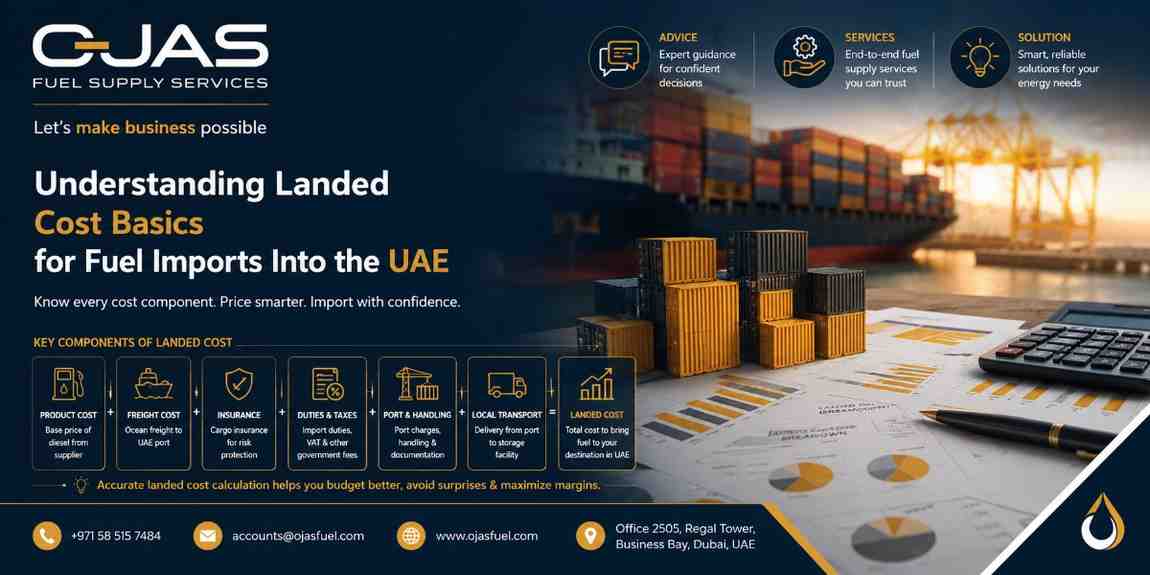
Landed cost is the total price of a diesel or MDO shipment once it reaches your UAE terminal or vessel. It combines product price, freight, insurance, customs duty, and VAT, not just the quoted fuel rate.
The full stack includes the base product cost for 10 PPM Ultra-Low-Sulphur Diesel (EN 590/Euro V) or Marine Diesel Oil (MDO), freight, marine insurance, customs duty, VAT, port handling charges, and documentation fees.
How Is Landed Cost Calculated for a Diesel or MDO Shipment?
UAE landed cost follows a fixed sequence. You start with the CIF value, apply customs duty on that value, apply VAT on CIF plus duty, and then add port and handling charges.
Federal Customs Authority guidance on u.ae states the standard customs duty rate is 5 percent of the value of goods plus cost, freight, and insurance for most imported goods categories.
Product availability, pricing, and delivery lead time remain subject to market conditions, product source, destination, and commercial terms agreed upon at the order stage.
Confirm the exact duty rate for your shipment directly with Dubai Customs before finalizing a budget.
FOB vs. CIF: Which Incoterm Applies to My Fuel Import?
Under FOB (Free on Board), you arrange and pay for freight and insurance from the loading port. Under CIF (Cost, Insurance, Freight), the seller bundles those costs into the price.
The ICC’s Incoterms 2020 rules fix the same risk transfer point for both terms: the moment goods are loaded on board the vessel at the port of shipment.
| Factor | FOB | CIF |
| Who arranges freight | Buyer | Seller |
| Who arranges insurance | Buyer | Seller |
| Risk transfer point | On board vessel at loading port | On board vessel at loading port |
| Best suited for | Buyers with own freight arrangements | Buyers preferring one bundled quote |
Even though CIF bundles freight and insurance into the seller’s price, risk still passes to you at the same loading port moment as FOB, per the ICC’s Incoterms 2020 explanatory notes.
Also Read: What Incoterms Should You Use When Buying Diesel from a UAE Exporter?
Does the UAE Charge Customs Duty on Imported Diesel?
Diesel imports into the UAE mainland are generally assessed at the rate published by the Federal Customs Authority on u.ae, currently 5 percent of the CIF value.
Product availability, pricing, and delivery lead time remain subject to market conditions, product source, destination, and commercial terms agreed at the order stage, so confirm this rate with Dubai Customs before finalizing a budget. Free-zone treatment differs and must be confirmed separately.
Is VAT Charged on Imported Fuel in the UAE?
Standard UAE VAT applies on the customs value plus any applicable duty, and the Federal Tax Authority confirms the standard rate stands at 5 percent in its published guidance.
Product availability, pricing, and delivery lead time remain subject to market conditions, product source, destination, and commercial terms agreed at the order stage, so confirm the exact computation against current FTA guidance for each shipment.
What Licensing and Documentation Affect Landed Cost?
Diesel imports require a Petroleum Products Trading Permit under Federal Law No. 14 of 2017, plus a Certificate of Analysis, commercial invoice, and delivery documentation.
The law states a Trading Permit is valid for one year and applies across the UAE, including free zones. Confirm current permit procedures with the competent authority in your emirate before booking.
Why Do Supplier Quotes Differ From Published Market Prices?
Published diesel benchmarks reflect wholesale trading levels, not landed cost, and the gap widened through 2026.
Reuters reported on August 10, 2026, that U.S. ultra-low sulfur diesel futures rose 7.4 percent in a single session on tightening global supply.
A separate Reuters report on August 13, 2026, noted diesel cargoes costing more than jet fuel in Europe for the first time in over a year, as the region competed for limited supply.
These movements widen the gap between an online benchmark and the delivered price a supplier quotes.
What Port Charges Apply at Jebel Ali and Fujairah?
Beyond product cost and customs, landed cost includes terminal charges such as marine or berthing fees, and each gateway sets and publishes its own tariff schedule.
Fujairah Port publishes an official tariff book covering marine charges, and Jebel Ali Port’s operator, DP World, publishes a separate official schedule.
Product availability, pricing, and delivery lead time remain subject to market conditions, destination, and commercial terms agreed upon at the order stage, so confirm current fees against each port’s own tariff book.
Frequently Asked Questions
- What does “landed cost” mean for a diesel import into the UAE?
It is the full delivered price once diesel reaches your UAE terminal, including product cost, freight, insurance, customs duty, VAT, and port charges.
2. Is customs duty charged on diesel imported into the UAE mainland?
Mainland imports are generally subject to the rate published by the Federal Customs Authority on u.ae, currently 5 percent of the CIF value. Confirm current treatment with Dubai Customs before finalizing a budget.
3. How is VAT applied to a diesel shipment in the UAE?
Standard UAE VAT of 5 percent applies on the customs value plus any applicable duty, per Federal Tax Authority rules. Confirm the exact computation against current FTA guidance for each shipment.
4. What is the difference between FOB and CIF pricing for fuel cargoes?
Under FOB, you arrange freight and insurance. Under CIF, the seller bundles those costs in. Both transfer risk at the same point, per the ICC’s Incoterms 2020 rules.
5. Do I need a permit to import diesel into the UAE?
Yes, Federal Law No. 14 of 2017 requires a Petroleum Products Trading Permit, valid for one year and issued by the competent authority in your emirate.
Request a Landed Cost Quote
A landed-cost figure built around your actual shipment beats a generic online benchmark.
Ojas Fuel Supply Services LLC coordinates Import/Export Facilitation for 10 PPM Ultra-Low-Sulphur Diesel and Marine Diesel Oil moving through Jebel Ali and Fujairah, helping you trace documentation, permits, and customs requirements against your delivery point.
Share your shipment volume, preferred port, and Incoterm, and request a landed-cost quote that reflects your specific route and current market conditions.