Ojas Fuel
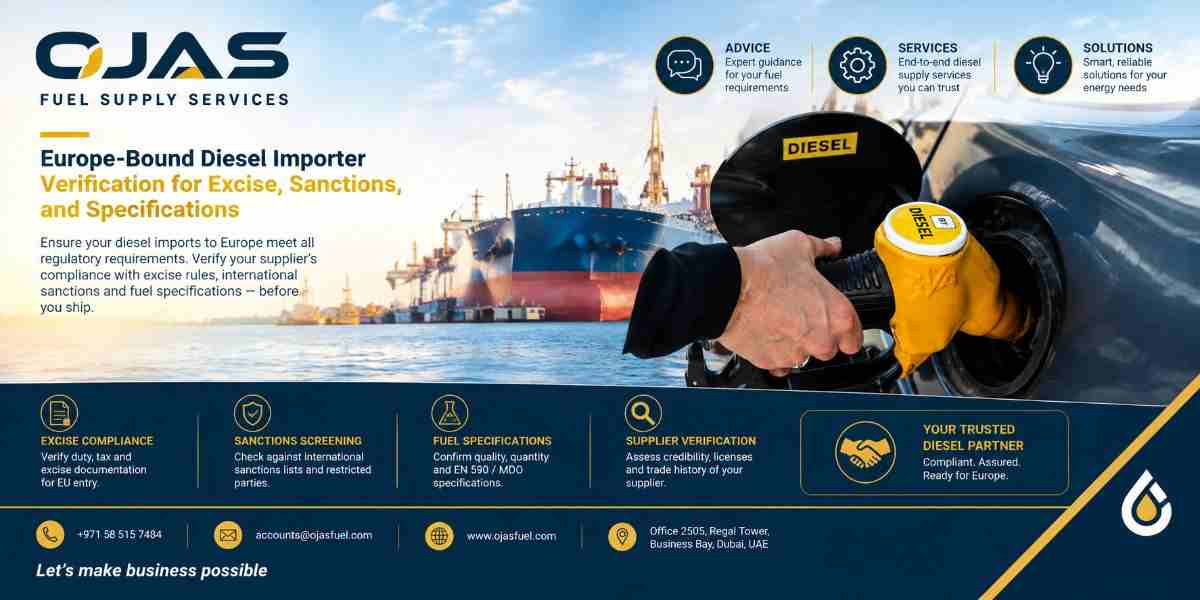
Europe-Bound Diesel Importer Verification for Excise, Sanctions, and Specifications
At a glance
- Identify the country of consumption, importer of record, and excise route.
- Verify the product’s origin and your sanctions evidence before loading.
- Match the specification and Certificate of Analysis to the batch.
- Align contract, UAE export records, bill of lading, and EU customs data.
- Name the ICC Incoterms 2020 rule and place.
Before signing, verify the destination country’s excise route, importer registrations, sanctions evidence, applicable 10 PPM Ultra-Low-Sulphur Diesel (EN 590) parameters and document trail.
Align these checks with quantity, payment method, delivery window, and the intended UAE gateway.
- Name the country of consumption, not only the first EU port.
- Confirm the importer of record, EORI number, and excise counterpart.
- Decide whether the cargo enters duty-paid or under duty suspension.
- Complete origin and sanctions checks before contracting.
- Record the ICC Incoterms 2020 rule and named place.
OJAS coordinates Europe-bound enquiries through Import/Export Facilitation from Jebel Ali Port or Fujairah Port.
The minimum order is 13,000 Imperial Gallons, approximately 59,100 liters, or roughly 49 metric tons of diesel, density-dependent. Payment terms are Upfront, Cash on Delivery, or Bank Transfer on Delivery Before Offloading.
Product availability, pricing, and delivery lead time remain subject to market conditions, product source, destination, and commercial terms agreed at the order stage.
Are excise duties applied at the EU or national level, and when are they payable?
EU law sets minimum excise rates, but each Member State applies its own rate and administration. Imported diesel becomes subject to excise on import, while payment can stay suspended until release for consumption.
Confirm the country of consumption, liable operator, guarantee, and movement route before shipment.
| Verify | What to confirm |
| Duty point | Whether the diesel is released for consumption or enters duty suspension. |
| EMCS | The electronic administrative document and reference code for suspended movements. |
The Commission’s Taxation and Customs Union states that an EORI number is mandatory for customs clearance in the EU.
Check the EORI and excise authorizations through the national authority and the SEED database. Never treat the EU minimum as your final tax cost.
What sanctions evidence must the importer obtain before loading?
Start with the refined product’s non-preferential origin. Article 3ma of Regulation 833/2014 has restricted covered CN 2710 products made from Russian-origin crude since January 21, 2026.
Products originating in a net crude exporter benefit from a rebuttable presumption, so upstream crude evidence is not always routine.
- Confirm the CN classification in TARIC, not only the commercial description.
- Obtain proof of the product’s non-preferential origin.
- Check the Commission’s current net-exporter list, which named the United Arab Emirates in its June 15, 2026, guidance.
- Where no presumption applies, obtain evidence of the crude extraction country.
- For refineries processing Russian crude, request segregation evidence and a cargo-specific attestation covering the 60 days before the bill-of-lading date.
- Add a contractual guarantee of non-Russian crude origin, in place no later than import.
The Commission’s FAQ states that authorities may rebut the presumption with reasonable grounds and that customs may request further documents. Article 3ma also prohibits related brokering, financing, and insurance services.
Which specifications and test documents show destination suitability?
A 10 PPM label confirms only the sulfur threshold and does not establish full EN 590 conformity.
The contract and Certificate of Analysis should identify the agreed standard, test methods, batch, and destination climate grade. Sampling terms should link the tested material to the shipped cargo.
| Parameter | EU reference point |
| Sulfur | Maximum 10 mg/kg |
| Cetane number | Minimum 51.0 |
| Density at 15°C | Maximum 845.0 kg/m³ |
| 95% recovered by distillation | Maximum 360 C |
| Polycyclic aromatic hydrocarbons | Maximum 8.0% m/m |
Annex II of Directive 98/70/EC lists these limits and refers to EN 590:2013+A1:2017 test methods. The table does not replace the complete standard, FAME rules, or national requirements.
Request a specification annex, batch Certificate of Analysis, sampling protocol, batch-to-cargo traceability, and a remedy for off-specification products.
Which documents and Incoterms details should align?
Every record should describe the same cargo. Match parties, products, quantities, origins, destinations, vessels, dates, and contract references across commercial, customs, sanctions, and quality records.
ICC advises naming the Incoterms rule, a precise port or place, and the 2020 edition.
| Stage | Documents and checks |
| Offer and contract | Quantity, payment, specification, inspection, sanctions clauses, Incoterms rule, and gateway. |
| UAE export | Invoice, packing or quantity record, certificate of origin, export declaration, bill of lading, and any required permits. |
| EU import | EORI, entry summary data, customs declaration, TARIC classification, origin evidence, and excise records. |
For Dubai declarations, Dubai Customs lists an invoice, packing list, certificate of origin, and permits from restricted entities.
Confirm equivalent requirements for Fujairah Port with the competent authority. ICC states that Incoterms do not govern specifications, payment terms, or the effect of sanctions, so your sale contract must.
Frequently asked questions
- Is 10 PPM diesel automatically EN 590 compliant?
No. The label describes sulfur content, while EN 590 conformity depends on a wider set of limits and test methods.
Require an agreed specification annex, a batch Certificate of Analysis and evidence that the tested sample represents the cargo. Confirm the destination climate grade before contracting.
2. Is EU diesel excise paid at the first EU port?
Not always. Diesel becomes subject to excise on import, but payment can remain suspended until release for consumption.
Confirm the destination country, liable operator, guarantee, and EMCS route before arrival. Keep the movement reference with your shipment records.
3. What is the EU minimum excise rate for automotive gas oil?
The European Commission lists EUR 330 per 1,000 liters for gas oil used as a propellant.
This is a minimum, not your final national rate, and rates differ by country. Check the destination country’s rate, reliefs, and liable party before pricing the transaction.
4. What sanctions evidence should accompany EU-bound diesel?
Keep proof of the product’s origin and check whether a net-exporter presumption applies.
Where it does not, or authorities have reasonable grounds for doubt, the file may need crude-origin evidence and refinery attestations.
Recheck the regulation and Commission guidance before contracting and loading.
5. Can OJAS coordinate a Europe-bound diesel requirement?
Yes. OJAS can coordinate enquiries for 10 PPM Ultra-Low-Sulphur Diesel (EN 590) through Jebel Ali Port or Fujairah Port, subject to availability, destination compliance, and agreed terms.
OJAS acts as a coordinator and facilitator. The importer remains responsible for destination-country compliance.
How can you request a Europe-bound diesel quote?
Submit your destination country, discharge location, volume, delivery window, intended use, specification, inspection requirement, importer details, and excise route.
You may name Jebel Ali Port or Fujairah Port as your preferred gateway, subject to execution feasibility. OJAS reviews complete requests through Import/Export Facilitation.